Written together with AI. How, on the About
A 'Family Emergency' Text on LINE: Hacked Account or AI Scam?
Scammers impersonate family on LINE asking for wire transfers or game cards, and AI voice cloning now makes the trick more convincing. Real cases and police data on how to check, whether the message is text or a voice call.
In this article
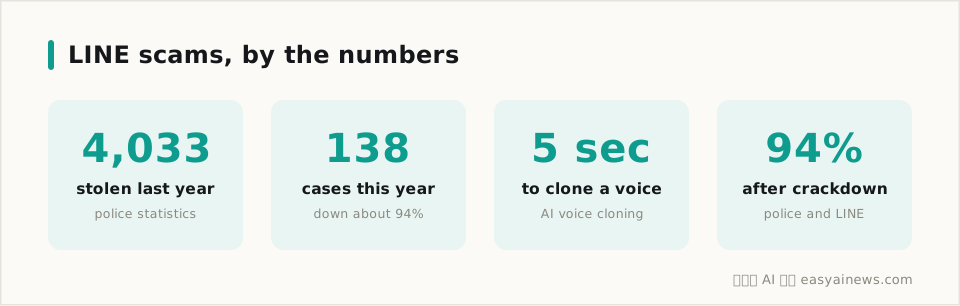
A message lands on LINE that reads like your sister or your best friend: something happened, send money now. Nine times out of ten, it's a scam. Taiwan's Criminal Investigation Bureau logged 4,033 cases of stolen or impersonated LINE accounts last year alone, an average of 336 a month. Once scammers get hold of an account, the first thing they usually do is message the victim's friends asking for a wire transfer or game cards.
This piece splits the problem into two shapes: someone typing at you asking for money, and someone actually speaking to you, by voice message or phone call. The mechanics behind each are different, and so is how you check them, so it helps to know which one you're looking at.
Is That Text Message a Hacked Account, or AI Writing on Someone's Behalf?
If it's pure text, it's almost always a hacked LINE account, not AI generating anything.
Police and LINE have spent close to two years chasing this pattern together. The entry point is nearly always a "help me vote" or "like this for me" link. Click it, hand over your LINE ID, password, and SMS code, and the account belongs to someone else within seconds. Nationwide, LINE account theft ran to 4,033 cases last year, about 336 a month. In the first seven months of this year, after police and LINE tightened the funnel together, that dropped to 138 cases total, roughly 20 a month, a decline of about 94 percent.
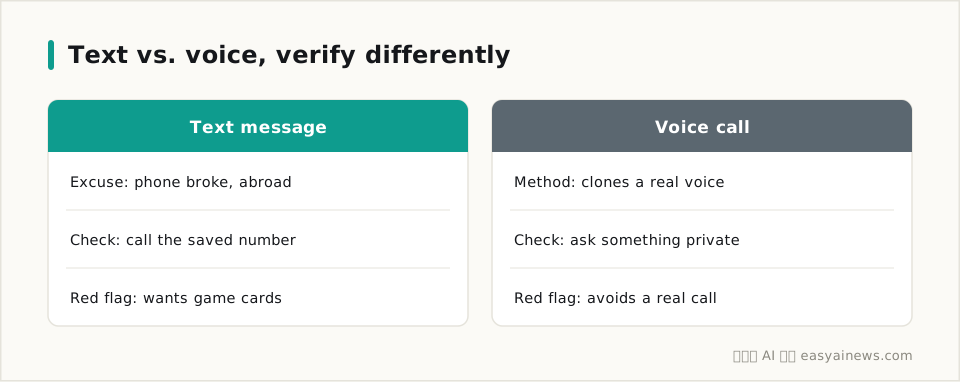
Once an account is stolen, the scammer rarely asks for money outright. They chat casually first, pretending to be your friend, then invent an urgent reason: a broken phone, being stuck overseas, a bill due right now. Game cards are the preferred payoff. Hand over the code on the back and the money is gone before any bank can freeze it.
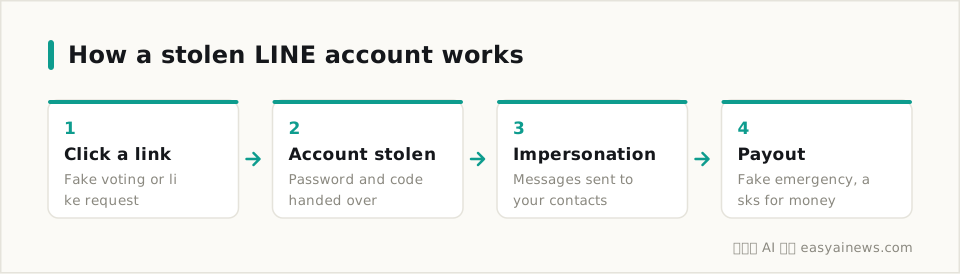
A stolen account is an old trick wearing new packaging. What actually got upgraded by AI shows up in the next scenario: someone doesn't type at all. They call, and they speak.
If Someone Actually Calls and Speaks, How Convincing Has AI Voice Cloning Gotten?
Feed an AI model five seconds of someone's voice and it can clone a near-identical copy, and this isn't theoretical anymore.
In July this year, a woman in Tainan received a LINE voice call that sounded exactly like her daughter, who lives far away. The caller claimed she urgently needed money for a house purchase and asked the mother to prepare a large sum in cash along with her bank card. The mother didn't suspect a thing. There was no audible flaw. She only found out once her daughter came home and the savings were already gone.
A well-known Taiwanese actor described a similar case involving his own family last year: his daughter first got a call from a fake market-research survey that quietly captured a sample of her voice, and not long after, his wife received a call that sounded exactly like their daughter, asking her to wire money. Taiwan's Ministry of Digital Affairs announced late last month it's partnering with Meta, Google, LINE, and TikTok to fight AI-driven fraud with AI of its own, cutting off suspicious messages closer to the source.
For more on spotting voice and video scams, a companion piece here covers that ground more fully. This one focuses on what's specific to LINE.
Whether it's a hijacked account typing at you or a cloned voice speaking to you, the messages tend to lean on the same handful of tricks.
What Red Flags Show Up in Both Text and Voice Scams?
Urgency, a request for secrecy, a specific payment method, and dodging a phone call: these four show up whether the scam is typed or spoken.
Urgency is standard: it's an emergency, there's no time to think it over. The point is to keep you from pausing. A request for secrecy keeps you from checking with anyone else, usually phrased as please don't tell anyone, I'm embarrassed. The payment method skews toward game cards or an unfamiliar transfer app, because once the code is handed over, it's cashed out before any bank can step in.
You might think, my friend really did break their phone once and borrowed someone else's account to reach me, and that does happen. The difference shows up when you actually call. A real friend with a broken phone answers when you call back. A fake one usually finds an excuse to dodge the phone entirely, something like just text me, I can't really talk right now. That line alone is one of the biggest red flags there is.
Once you can spot those flags, what's left is the handful of things you'd actually do the moment a message like this arrives.
You Got a Message Like This. What's the First Move?
Don't reply, don't transfer anything, don't click any link they send. Call the number you already had saved for that person, and that one step blocks most of these scams outright.
Ask something only the real person could answer: what you ate together last time, the name of the family cat. A cloned voice can't answer something that personal, and neither can whoever stole the account. If there's an older relative in the family, agree on a codeword nobody could guess in advance. It proves who's really on the line in seconds, and it's far less trouble than sorting things out after the money is gone.
You might worry that if it really is an emergency, losing five minutes to make that call could cost too much. A genuine emergency survives one more phone call. Whatever can't survive being checked is usually exactly the kind of urgency a scam depends on. If the account they want the money sent to doesn't carry the same name as the person supposedly asking, that alone is enough to treat it as fraud. When in doubt, Taiwan's 165 anti-fraud hotline is one call away. A little delay costs nothing next to money that's already gone.
Five Things Worth Remembering
- Get a LINE message asking for money or game cards. Call the number you already had saved, never one the sender just gave you.
- A voice message or call that sounds like family or a friend gets the same treatment: hang up, call back yourself, or ask something only they'd know.
- Agree on a codeword with family in advance, so a real emergency can be confirmed with one phrase.
- A payment account whose name doesn't match the person asking, or a request for game cards, is close enough to fraud to treat as fraud.
- Still unsure? Call Taiwan's 165 anti-fraud hotline. A short delay costs nothing next to a wire transfer that's already gone.
Stolen accounts and cloned voices sound like two different technologies, and in a sense they are. The fix is the same either way: make one more phone call, and actually check. Most of these messages don't survive that call.