 Easy AI News
AI-assisted, approved by the author. About
Anthropic reports a profit. Why is its credit rating BB+? Claude and OpenAI’s finances explained
A breakfast-shop guide to Anthropic’s reported adjusted profit, its BB+ credit rating, the debate on X, and why revenue comparisons with OpenAI need care.
In this article
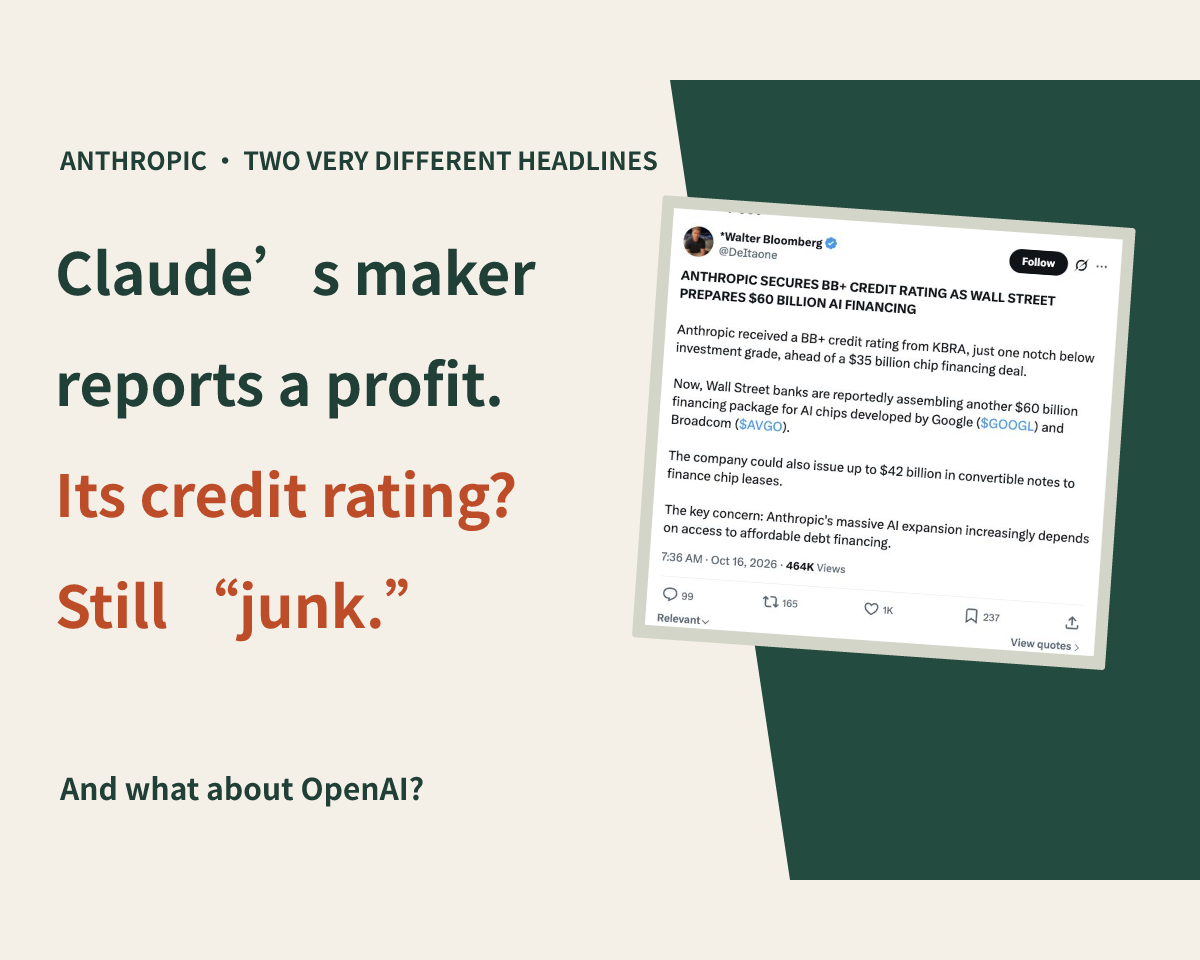
Two recent AI headlines look a little strange next to each other.
One says Anthropic, the company behind Claude, brought in $16.8 billion in third-quarter revenue, up about 45% from the previous quarter, and achieved an “adjusted profit.”
The other says its credit rating is BB+, a rating commonly described as “junk.”
Hold on. More than ten billion dollars in quarterly revenue, a profit, and somehow the word “junk” still fits? And what about OpenAI, the company behind the more familiar ?
Are our monthly subscriptions supporting promising businesses, or helping them pay the electricity bill?
A few different questions have become tangled together. Let’s separate them.
A lot of money comes in. How much stays?
Reuters, citing people who attended an October 14 investor meeting, reported that Anthropic’s third-quarter revenue reached $16.8 billion, versus about $11.6 billion in the second quarter. The company also said it achieved an adjusted profit in Q3. These figures come from reporting on a closed-door meeting; public detail remains limited. Reuters report
Start with revenue.
Imagine you own a breakfast shop. You sell a million dollars’ worth of breakfast wraps and milk tea in a month. That million is revenue. You still have to pay for eggs, flour, rent and staff. It may be a little early to start shopping for a new car.
AI companies face the same basic question.
Subscriptions bring in money. So do businesses paying to put Claude into their workflows. But every answer and every piece of code uses computing power. The company also needs to pay researchers, develop its next model and prepare enough capacity for more customers.
Having lots of people willing to pay is meaningful progress. We still need to know how much it costs to serve them.
Then comes the second important word: “adjusted.”
Headlines can easily drop it. Doing so changes what readers think “profit” means.
Companies sometimes exclude certain expenses and present an additional profit measure that they believe better reflects ordinary operations. This is common. The questions are what they excluded, and whether those expenses will keep recurring.
It is a little like the breakfast-shop owner saying, “Leave out a few expenses, and we made money this month.”
The explanation may be reasonable. But if one of those expenses arrives every month, it becomes difficult to keep looking past it.
Anthropic’s announcement therefore deserves attention and follow-up questions. “Adjusted profit” alone does not tell us how much remains after every expense is included.
What exactly does “junk” mean?
Now for the other headline.
The Financial Times reported on October 16 that credit-rating agency KBRA had assigned Anthropic a BB+ issuer credit rating back in June. It is the highest speculative-grade rating, one step below investment grade. That speculative category is commonly called “junk.” The rating was newly reported; this was not a recent downgrade. FT report, republished by Yahoo
It is a spectacularly unfriendly name. Encounter it for the first time, and you might assume someone has declared the whole company hopeless.
A credit rating concerns repayment risk. Its question is practical: if you lend this company money, how likely are you to get it back?
Return to the breakfast shop.
A friend opens a shop, attracts long lines in the first year and now wants to open fifty more. They might offer you one of two deals:
“Invest in the business. If we do well, we share the upside.”
Or:
“Lend me money. I’ll repay the principal on an agreed date and pay interest along the way.”
Both involve giving your friend money. They give you very different reasons to say yes.
As an investor, you might be willing to bet that this becomes the next major restaurant chain. Success could produce a substantial return.
As a lender, your interest is usually agreed in advance. If the whole world suddenly wants those breakfast wraps, you do not automatically receive ten extra shops. If the business fails, however, you may lose your principal.
Investors can be enthusiastic about the future while lenders still want steadier income, fuller financial information and resilience when something goes wrong.
BB+ signals repayment risk that warrants caution. It guarantees neither failure nor repayment. A rating assigned in June also cannot be treated as a fresh assessment incorporating all of the third-quarter results. KBRA’s rating definitions
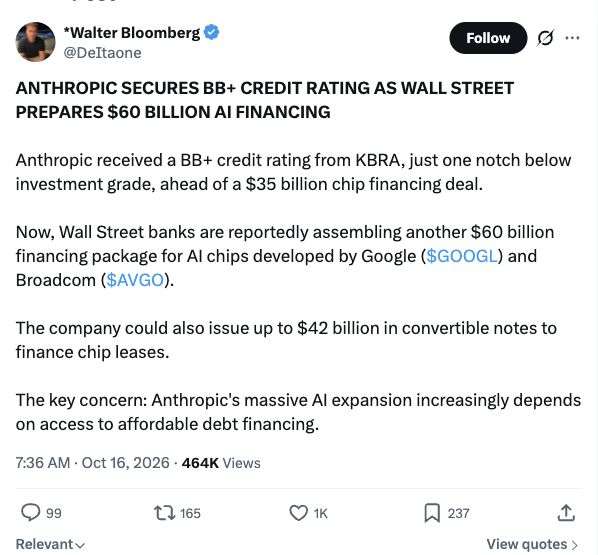
The news-summary post highlights both the proximity to investment grade and the importance of affordable financing.
On X, the debate runs from growth to computing costs
That is what makes this discussion interesting. Some people see a remarkably fast-growing company. Others see a bill whose details are still hard to read.
Technology writer Gergely Orosz defended Anthropic on X, emphasizing that a company founded only five years ago could already be compared with software businesses that had operated for decades. His point is straightforward: reaching that scale so young hardly sounds like a business running out of customers. Orosz’s post
The user he was responding to, Vay, asked whether Anthropic could become the first major AI bubble to burst. Vay’s post
There is another question between those positions: price.
A breakfast shop can be genuinely successful. Paying a million dollars for it and paying ten billion dollars are still very different propositions. A company can perform well while an investor pays too much.
“Useful product,” “profitable business” and “reasonable investment price” each need their own answer. Establishing the first does not automatically establish the others.
Another part of the discussion goes directly into the costs.
Josh You used different reported profit margins to infer that a substantial share of Anthropic’s computing expenditure might be classified as research and development. He began with “If I’m not mistaken.” This was a calculation based on limited information. Josh You’s post
AllThingsVentured quoted that post and made a stronger allegation: that unused computing capacity was being classified as R&D, making the service side of the business look more profitable. There is not enough information to establish that allegation. A confident tone does not make it a verified finding. AllThingsVentured’s post
The disagreement does identify a question worth understanding.
Some computing capacity serves current paying customers. Some develops the next model. Different classifications can change the appearance of a particular margin.
Someone still has to pay for all of it.
If developing each new model is essential to staying competitive, research spending belongs in a discussion of long-term profitability. Every generation cannot simply be “the one we leave out this time.”
What about OpenAI, the company behind ChatGPT?
At this point, a natural question is: if Claude’s maker is reportedly turning a profit, how is ChatGPT doing?
The comparison adds another complication. The two companies’ revenue figures may not be directly comparable.
Axios reported that OpenAI and Anthropic use different revenue-recognition approaches for some sales through partners. Axios report
Think of a breakfast shop joining a delivery platform.
The customer pays $100. The platform keeps $30. The shop receives $70.
One way of presenting the transaction is: “We sold $100 and paid the platform $30.”
Another is: “Our revenue from this transaction is $70.”
Look only at the revenue line and one business shows $100 while the other shows $70. That difference alone tells you very little about which business kept more money.
This is a simplified illustration. Actual accounting depends on the roles and responsibilities of the parties. A difference does not, by itself, establish that anyone is improperly inflating revenue.
News reports also frequently use “annualized revenue.”
It can sound like money already collected over a year. It may instead mean taking the latest month’s revenue and multiplying it by twelve to describe the current scale of the business.
If your shop makes a million dollars this month, keeping up that pace would produce twelve million over a year. That is useful . But perhaps the shop was not even open in January, and perhaps a new competitor will appear next month. Actual full-year revenue remains to be seen.
Before comparing AI companies, we therefore need to ask: are these figures for the same period? Are they recognized revenue or an extrapolation from the current pace? Do they include money that goes to a partner?
Otherwise, a tidy ranking may just be arranging different calculations in a neat row.
Freda Duan offered another observation on X: the companies can raise expectations for each other. A higher reported valuation for one becomes a new reference point for the other. More ambitious growth expectations create pressure to explain why a competitor’s outlook should be just as exciting. This is her interpretation of the competitive dynamic. Freda Duan’s post
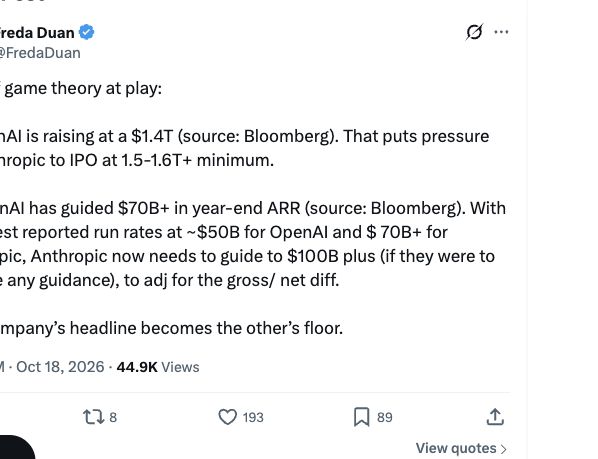
Duan argues that one company’s headlines raise expectations for the other. The targets and projections in her post are not realized revenue.
It is like the shop next door announcing plans for a hundred branches next year. You had planned twenty. Suddenly you are explaining why you are “only” opening twenty.
Whether those twenty can make money still requires its own calculation, regardless of what the neighbor announces.
So which company is more profitable?
There is reporting that Anthropic achieved an adjusted profit. To rank the two companies reliably, we still lack complete income and expense information for the same period, prepared on a comparable basis.
ChatGPT’s popularity does not show that OpenAI profits from every person it serves. Businesses paying for Claude do not remove the cost of Anthropic’s future research and expansion.
If it is profitable, why does it keep needing money?
Today’s income and tomorrow’s spending plans can be on very different scales.
Reuters reported that Anthropic had committed at least $518 billion over the next ten years to cloud services, computing and infrastructure. These are multiyear commitments, not a pile of debt all due today. They do show the scale of the expansion being planned. Reuters report
A profitable breakfast shop does not automatically have enough cash to open fifty branches.
If borrowing is expensive, each new branch carries a heavier interest bill before it even opens. A small shortfall in future sales can then become much more painful.
This is why credit ratings matter for AI companies. Better ratings generally help lower financing costs and can open access to institutions whose investment rules limit what they can fund. The FT report also described Anthropic’s BB+ as a step toward investment grade. FT report
The same rating produces two reactions:
“Look, it is still junk.”
“It is already just one notch away.”
One puts more weight on the risk being taken now. The other puts more weight on where the company might go next.
What does any of this mean for subscribers?
Most of us will not buy stakes in these companies or lend them billions. We do use their services.
If AI companies can provide features people keep paying for at a reasonable cost, the business has a better chance of lasting. That also improves our chances of continuing to get useful products.
If spending persistently exceeds income, something needs to change. A company could raise prices, adjust usage limits, move expensive features into higher subscription tiers, or reduce costs through technical improvements. Those are possibilities. A single credit rating does not tell us that Claude is about to increase its prices.
Our current subscription price is still far from the final answer to this competition.
AI companies are working out which features people will keep paying for, how much they need to charge and what it costs to deliver them well.
Anthropic’s revenue growth deserves to be taken seriously. Whether that growth can keep producing enough profit to support the next round of huge investments needs fuller financial information and time. Bringing OpenAI into the comparison does not remove those questions.
“Junk” catches the eye. It cannot settle the case for an entire company. “Turned a profit” also deserves a look at the explanation that follows.
Claude and ChatGPT helping us finish our work is valuable. Whether their companies can make the numbers work is a story we will be watching for a while.