Easy AI News 輕鬆的 AI 新聞
I read it, then share it

The easiest AI news, every day

There's a lot of AI news every day, and keeping up with all of it is hard. So I have a habit: I save what I come across, let AI turn it into one short piece each day, and I share it here too.

Latest

See all →
Jul 16, 2026 AI & Thinking

In the AI era, your fragmented attention might actually be fine

Seventy percent of Gen Z say they're worried AI will hurt job prospects. In the same Gallup poll, a quarter said they wish smartphones had never been invented. This is the first generation that grew up with them. This summer in New York, a group organized something called Summer of Ludd: no phones allowed, no social media promotion, attendees chanting "No Gemini, no GPT, no Claude." The neo-Luddite movement isn't against technology as such. It's against algorithms, data tracking, and how tech has quietly eaten into social life and sleep. What's funny is that this anti-social-media event spread mainly through TikTok. Around the same time, a Harvard undergraduate asked a question: does reading still matter in the AI era? She couldn't focus long enough to finish a book. Her classmates were forming reading groups; she felt left behind. The answer she got surprised her: if you can't read one book, read ten at once. Pick one up, read five pages, lose focus, put it down, pick up another. Ten books running simultaneously, no commitment to any of them. Without the weight of "I have to finish this one," you start finding unexpected threads connecting them. The advice rests on an observation: you're trying to fit yourself into a format most people find hard, reading straight through from cover to cover in one sitting. Academia figured this out centuries ago. The reason papers have abstracts, topic sentences, and section headers is that even full-time scholars have short attention spans. AI has exploded the amount of information available. Your brain is still the version that needs to come up for air. The Summer of Ludd logic and the reading advice are saying the same thing. They organized on TikTok, then put their phones away when they arrived. When the event ended, the phones came back out. What they were practicing was the act of choosing, directing attention toward what they decided. Next time you want to put a book down halfway through, put it down and pick up another one. You've always read this way.
Jul 15, 2026 AI Reality

AI Has Read More Code Than Anyone, and Never Understood a Line

In 1952, Grace Hopper sat down at a Mark I computer and finished the first compiler. The concept was simple: let a person write "ADD" and have the machine translate it into binary. Before that, programming meant speaking the machine's own language directly. After that, you spoke, and the machine translated. That chain extended for 70 years, all the way to today's AI code generators. Say "write me a function that takes a city name and returns today's weather forecast." Within seconds, working code appears, complete with docstrings, ready to run. The speed at which AI writes code already surpasses any human engineer. But none of that involves thinking. The model may have read more Python than every software engineer on earth combined. Its mechanism, though, is prediction: given billions of training examples, find the token most likely to follow statistically. It knows what typically comes after "city name input." Why that is, it can't tell you. Seventy years ago, Hopper's compiler was translating. Today's AI is still translating. The target has just shifted to your own words. There's a practical problem with this translation machine: developers accept roughly 30% of what it suggests. The other 70% gets read and deleted. And of that 30% that does get accepted, studies find around half carries known security vulnerabilities: syntactically clean, looks right, but hiding problems inside. That same week, the University of Chicago Law School announced something that looked like the opposite: starting this year, first-year students can't bring any devices to class, not even laptops. The school's position isn't that AI is bad. It's that students need a space without a translation machine first, where thinking has to do the work on its own. The approach is Socratic: professors ask, students answer in real time, reading cases themselves, tracing arguments themselves, finding the flaws in logic themselves. The point is that by the time students do use AI, they can actually judge whether what it produced is right. AI has pushed translation further than 1952 could have imagined. Chicago is saying: before you let AI do the translating, understand what you're translating first. Both things happening at once. Neither is wrong. That 70% of AI code suggestions that didn't make it: generated, then gone. Next semester, Chicago's first-year students walk in, desks clear, professor asks, they think.
Jul 14, 2026 AI & Learning

When AI Writing Can Pass as Human, What Happens to Trust?

Jie Ding, a researcher at the University of Minnesota, built a tool called Academic Humanizer. His reasoning was direct: existing AI detection tools are far too unreliable, routinely misclassifying human writing as AI-generated and wrongly penalizing students. His tool helps users rewrite sentences to sound more human. Days later, Nature ran a piece on it. Academia erupted. The debate that followed centered on one question: does this tool make it easier to pass off AI-generated work as human? But if AI detectors regularly misclassify human writing, the detection problem is not actually the real issue. The question underneath is: when a piece of writing reaches you, what is left of the trust between you and whoever wrote it? When a student submits an assignment, or a researcher submits a paper, there is an implicit understanding at work: you claim authorship, and the reader takes your word for it. Academic Humanizer and tools like it have made that underlying trust harder to lean on. The same week, New York City froze all new AI-tagged educational software purchases, calling for consensus before moving forward. Three separate groups spoke up: privacy advocates, teacher unions, and a broader coalition. More than four thousand signatures called for a two-year halt. That freeze is an admission: in an AI-saturated environment, no one has figured out how to rebuild this kind of trust. The question reaches further than education. Any article, report, or message you receive, you are now quietly running the same check: this person says they wrote it. Do I believe them?

Want a whole AI topic in one read?

All long reads →
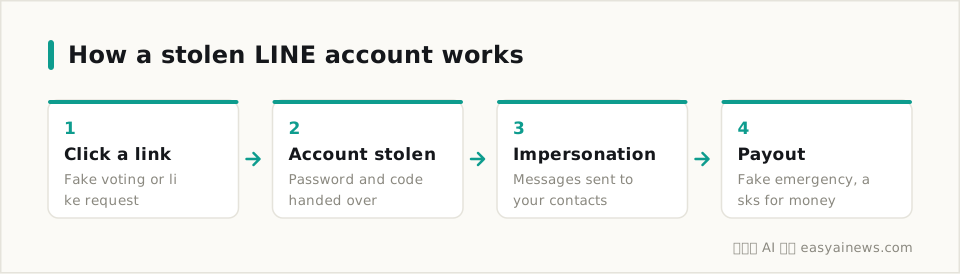
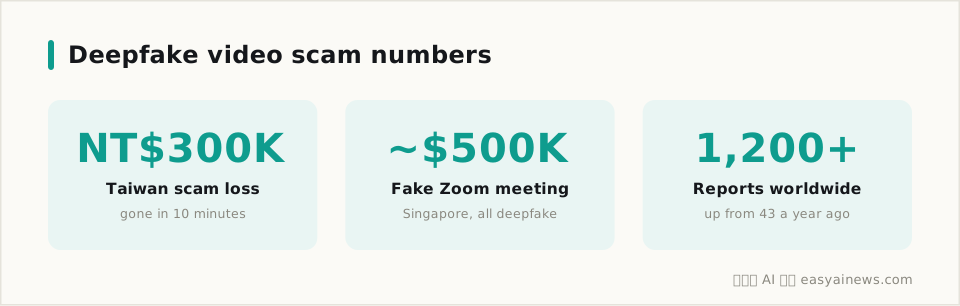
The Brown University AI Cheating Scandal Is Really Just a Gut-Course Story A chart of a Brown economics class's midterm-vs-final scores went viral as an AI cheating scandal. My take differs from most: the midterm collapse was baked in the moment it became an easy A. The people worth discussing are the few who still gambled on the in-person final. Read more → Asking a Person Used to Be a Win-Win. Asking AI Only Wins Once. When I get stuck at work, I ask AI now, not a coworker. Engineers asking technical questions do the same. But asking a person, whether a coworker or a public forum, used to leave something behind for someone else too. Here's what disappeared along with that. Read more → I Caught the AI That Writes My Posts Saying the Same Thing Over and Over The daily posts here are written by AI, and I say so openly. Then I lined up a dozen recent ones and most of them looked alike. This is how I caught it and what I changed, typed by hand, because the whole point of the piece demands it. Read more → Which Jobs Will AI Replace, and Which Ones It Probably Won't Will AI really take your job? In plain language: which kinds of work get hit first, which stay safer, why people who can judge are worth more than people who can just do, and one thing you can try today no matter your field. Read more → What Is ChatGPT? A Plain-English Guide for People Who've Never Tried It A jargon-free intro to ChatGPT. What it actually is, whether it costs money, how to start the first time, the everyday things you can use it for, and a few things to be careful about. Read more → How to Spot AI Scams and Fake Messages: A Self-Defense Guide for Everyone AI makes fake videos, fake voices, and fake messages startlingly real, and both older folks and younger people get caught. Here are a few checks anyone can use, no tech skills needed, to protect yourself and your family. Read more →
Topics

Browse by topic

Every post is filed under a topic. Tap one to see more like it.

See all posts →
Easy AI News
The AI news I round up for myself, and share with you
© 2026