 Easy AI News
AI-assisted, approved by the author. About
AI Will Cure Cancer, So Why Not Smoke? Silicon Valley’s Health Bet
What Silicon Valley’s smoking claims reveal about humor, technological faith, and betting your health on future AI medicine.
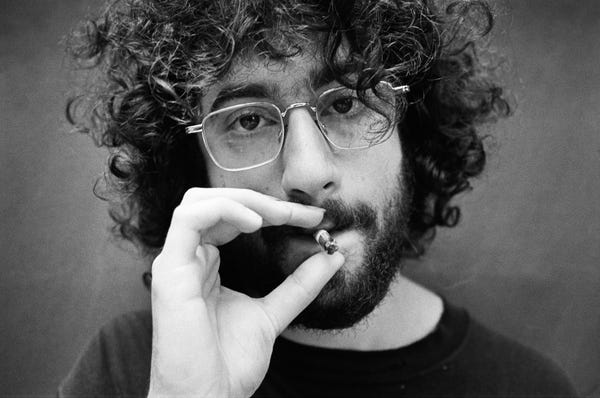
Avi Schiffmann. Photo courtesy of We’re Not Really Strangers, via Business Insider.
A strange claim has been making the rounds: some AI researchers are taking up smoking because they believe AI will eventually cure cancer.
That is a remarkably specific way to express confidence in a technology.
Most people might buy shares, pay for a subscription, or tell a friend to try it. In this version, your lungs get to participate too.
The latest discussion followed an interview with Palantir technology chief Shyam Sankar. Evidence for a widespread trend remains thin. 1
There is at least a named founder who has offered this rationale. Avi Schiffmann, who runs AI wearable startup Friend, invoked future AI treatment for lung cancer when discussing smoking with Business Insider. Other people in the same report described socializing, taking a break, and attracting attention. 2
So hold off on imagining an entire AI lab lighting up while urging its model to hurry up and develop the medicine they will need.
Some people smoke. Some expect AI to transform cancer treatment. Those groups overlap. But already smoking and invoking AI as a reassuring explanation is quite different from starting specifically to demonstrate faith in it.
Which raises the interesting question: how seriously do they mean it?
Two replies to the same X post sharing the interview illustrate the ambiguity.
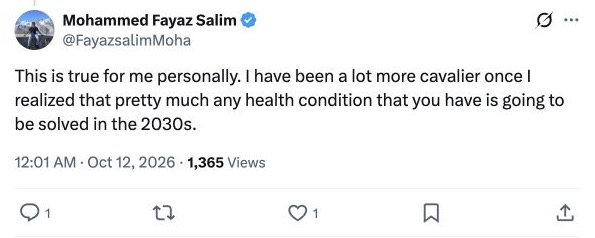
This reply explicitly connects expectations about medicine with a more casual attitude to health risks. It does not say that the author started smoking because of AI.
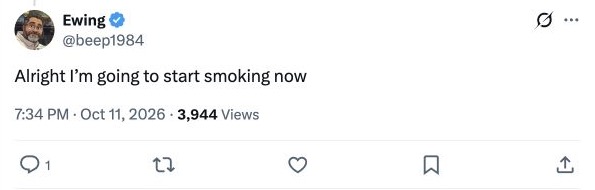
This could be a joke or a statement of intent. The post alone does not establish that the author actually began smoking.
We tend to sort technology talk into serious predictions and jokes. A single remark can contain both. Someone can know a line is outrageous, enjoy the reaction, and still think: well, it might actually happen.
Take the idea seriously for a moment, and it becomes a bet about timing.
Some serious consequences of smoking may take years to develop. If medicine improves quickly enough in the meantime, a risk that looks substantial today might become less frightening later.
That is our reconstruction of the argument, not a claim that every smoker has worked through it. It does, however, help explain how someone could consider the choice less reckless than it appears to everyone else.
How many things would have to go right for that bet to pay off?
AI would need to help produce an effective treatment. That treatment would need to be tested in time. It would need to work for the particular disease you develop, and you would need access to it when you need it. Each is something to hope for. A failure at any step can leave the original confidence doing very little practical work.
And smoking does not wait until a lung cancer diagnosis to send the bill. Cardiovascular disease, chronic lung disease, and harm to other people through secondhand smoke remain part of the picture, even in an imagined future with better cancer treatments. 4
There are real reasons to be optimistic about AI in medicine. Researchers use it to analyze cancer images, investigate disease mechanisms, search for drugs, and predict treatment responses. These are active areas of research. Benefits for patients still require rigorous validation. 3
The question worth lingering on is how someone moves from “this technology is promising” to “I can worry a little less about the consequences today.”
If your friends and colleagues spend their days talking about the enormous changes AI will bring, a line like “it will be treatable by then” can do several jobs. It can reassure you, make your friends laugh, and show how invested you are in that future.
Through that lens, a cigarette can acquire a social meaning. The available reporting cannot tell us how much that meaning drives any particular person's behavior.
Nor do we need to treat the underlying habit of thought as uniquely mysterious to Silicon Valley. “I'll catch up on sleep after this deadline” and “I'll exercise tomorrow” also put the repair work in the future. Here, the technology assigned to do the repair has no confirmed delivery date.
I want to understand that optimism, and I take the possibility of medical progress seriously. I still think this is a bet being placed too early.
Hoping AI makes cancer easier to treat and deciding whether to light a cigarette today can be separate decisions.
If that future arrives, reaching it in good health hardly seems like a failure of faith.