 Easy AI News
AI-assisted, approved by the author. About
Grok X Subscription explained: prices, reactions, and the challenge of getting people started
What Musk’s AI bundle includes, how its five pricing tiers differ, why Cursor users object, and what ChatGPT, Claude and Muse reveal about getting started.

In this article
- Forget the names for a moment. What could you do with it?
- Free to $200 a month: what changes?
- “It is already included. I might as well try it.”
- Some welcome the bundle. Others worry about losing what they valued.
- Having the tools is only the beginning
- ChatGPT, Claude and Meta are moving toward everyday work
- Someone still has to hand over that first task
Elon Musk, 2018. Photo: Debbie Rowe / The Royal Society, CC BY-SA 3.0.
Elon Musk has bundled several services into one subscription: chat with AI, make images, ask an assistant to carry out tasks, and get help writing code. It also includes paid features on X, formerly Twitter.
If you did not know Musk had an AI product, it is called Grok. Think of it, initially, as his version of .
The new offering is called The X Subscription. For people who follow AI every day, it rearranges prices and features. For everyone else, even what these tools do may need explaining.
That is why I find the integration promising. Figuring out which AI tools exist, what each does, and where to use them is already exhausting. Having someone put the pieces together, so I can concentrate on asking for help, would be welcome.
Once the tools are bundled, though, will people actually start using them?
Forget the names for a moment. What could you do with it?
Imagine running a small shop and planning an event. You might need research, ideas, promotional copy, an image, and a registration page. AI tools can already help with those jobs. Choosing the tools could still take half an afternoon.
These are the main parts of the bundle:
| Tool | A simple way to understand it |
|---|---|
| Grok | AI for conversation, research, and generating images and video |
| Grok Bot | An AI assistant that uses tools and carries out work in multiple steps |
| Cursor | A tool for writing and changing code, including building websites |
| X membership | Paid social features, such as fewer ads and additional posting and analytics tools |
This describes the product family. The cheapest plan does not include every feature. Official announcement
That is enough names for now. AI companies introduce so many of them that keeping up starts to feel like vocabulary homework.
What matters is that these tools can go beyond answering questions to producing images, documents and websites, or operating software. Being able to help and reliably finishing the job are still different milestones. We will return to that.
Free to $200 a month: what changes?
There are five tiers. These are US-dollar monthly prices before tax, checked on October 14, 2026:
| Plan | Per month | Main differences |
|---|---|---|
| Free | $0 | Limited chat and access to selected tools |
| Plus | $8 | Chat, voice, image generation, coding tools and X membership benefits; no Grok Bot |
| Premium | $30 | Adds Grok Bot, latest Grok models, video generation, cloud coding agents and automation; 4× the Plus usage allowance |
| Super | $100 | Premium features, 15× the Plus allowance, and priority model access during peak periods |
| Ultra | $200 | Super features, with 50× the Plus allowance |
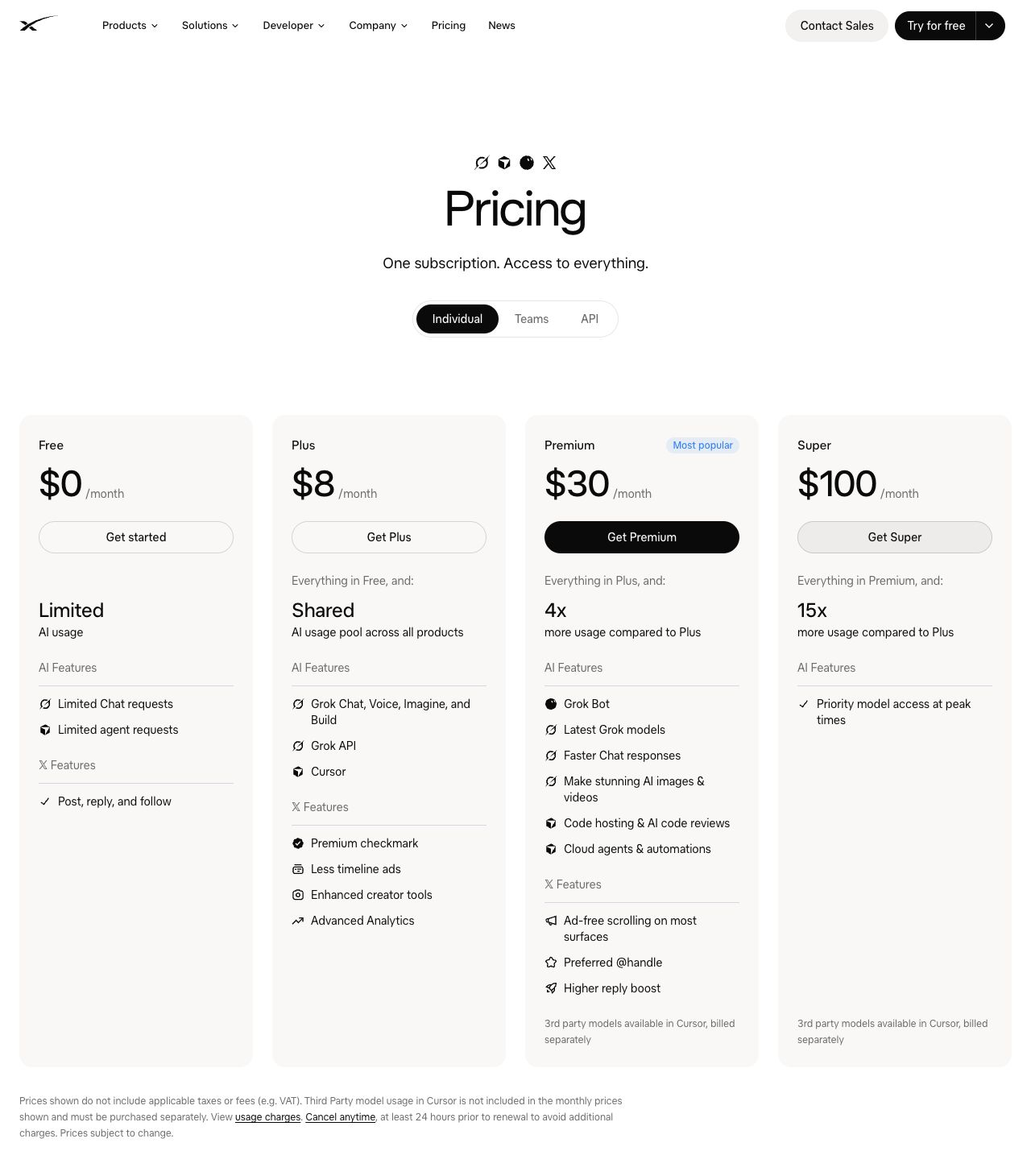
For someone who wants an AI assistant to carry out work, $30 a month is the important threshold.
Eight dollars covers chat, images and coding tools. An assistant you can assign work to starts at thirty.
The $100 and $200 tiers mainly increase how much you can use. Asking for occasional help and assigning a full workload consume different amounts. Paying for the highest tier does not suddenly make it understand your intentions better.
The eligible first-party AI tools share a weekly usage pool. Think of a mobile data allowance: streaming, browsing and downloading all draw from the same pool. Different AI tasks consume different amounts, so the allowance cannot be translated directly into a fixed number of questions. Usage rules
Bundled access does not mean unlimited use. Once the allowance runs out, you can wait for the reset or buy more usage. Third-party models in Cursor, including Claude and GPT, require additional payment from the first request.
Annual prices are $80, $300, $1,000 and $2,000, equivalent to roughly $6.67, $25, $83.33 and $166.67 a month. Pricing documentation
For someone still discovering what AI can do, integration offers a practical benefit: every new use need not trigger another investigation into which service to buy.
“It is already included. I might as well try it.”
I am optimistic about integration. Fewer plans to investigate and fewer settings to work through are real conveniences.
Many people still open ChatGPT occasionally to ask a question. If other tools are already available, trying one is easier than finding a new service, creating an account and deciding whether to pay.
Subscription-business publication Subscription Insider argues that the bundle can bring users across products. Paying X users may try Grok or Cursor; people paying for AI may start using the included X benefits. Whether that produces more paying customers or sustained use remains to be seen. Analysis
Buying a new service usually takes a reason. If it is included already, curiosity may be enough.
That first attempt matters. If AI successfully helps you finish a document, or build a webpage you thought you could never make, you may think of trying it again next time. Integration creates that opportunity. The first experience still needs to go well.
Some welcome the bundle. Others worry about losing what they valued.
One of the clearest objections comes from existing Cursor users.
Part of Cursor's appeal was being able to choose among different companies' AI models inside one coding tool.
In the official forum, coco_max, who describes themself as a long-time paying subscriber, criticizes the new plans for including Grok usage while charging separately for third-party models. They worry about losing the model choice that made Cursor valuable. Original comment
That objection makes sense. For someone who knows exactly what they need, a package of extras can still omit the thing they use most.
Existing customers can currently keep their previous plans, and third-party models remain available at additional cost. Everyone is not being forced onto the new bundle immediately. Official response
The tension is worth watching. Beginners may welcome fewer decisions. Experienced users may want more control over the components. How the company serves both groups will matter.
Having the tools is only the beginning
For people who have not used AI deeply, the immediate question is simpler: now that everything is available, will I know what to do?
Dave Voyles, who uses both Grok Bot and Meta's assistant Muse, describes a useful example. He planned to introduce Grok Bot into his father's business for email, client documents and research. He switched the initial rollout to Muse because it was easier to get started.
Voyles still runs a thoroughly configured Grok Bot setup himself. For his father, he prioritized getting to useful work quickly. Even then, he continued preparing instructions and background information behind the scenes. His account
His post predates the new subscription and cannot establish how well this bundle works. It does illustrate the gap between acquiring tools and using them successfully.
If getting started depends on having an AI-savvy family member spend hours configuring things, there is more work to do before the product becomes widely accessible.
Fewer separate purchases are convenient. Fewer hours figuring things out are convenient too.
ChatGPT, Claude and Meta are moving toward everyday work
Other AI companies are trying to close that gap as well.
ChatGPT offers Work for research and documents, Codex for programming, and dots for ongoing tasks. Its documentation describes dots handing work to Work or Codex, connecting those capabilities. OpenAI documentation
Anthropic connects Claude with finance, customer-management and office software. For people with established workflows, the appeal is help inside work they already do. Claude for Small Business
Meta's Muse emphasizes assigning tasks through familiar messaging, including its app and WhatsApp. Meta also has a separate Meta One subscription combining social features and certain AI benefits. They should not be treated as one identical package, but both approaches start from familiar services. Muse · Meta One
These products did not appear simply in response to Grok. A feature table cannot tell us who will win.
Together, they suggest a shared ambition: bring AI closer to people's existing lives and work. You might just want to finish your email, prepare a document, or spend less time on the shop's paperwork. You need not begin by deciding to study AI.
Someone still has to hand over that first task
The most interesting question is whether this bundle can help people move beyond “I know AI is impressive, but what would I use it for?”
That is still a hypothesis. Launching a bundle does not establish adoption. Putting a feature in a menu does not tell people when to click it.
Model capability matters. So do getting started, recovering when something goes wrong, and finding the finished work.
If your first experience ends at a confusing settings page, impressive capabilities will not help much. If the tool genuinely finishes something troublesome, you are more likely to return.
I think integrating the tools is a promising direction. I hope the companies put just as much care into the first useful experience: helping a shop finish its first event poster, or a parent organize an itinerary, so that the benefit becomes concrete.
Most people have no intention of becoming AI experts. They have something inconvenient to get done, and you can help them finish it.