Written together with AI. How, on the About
Can AI Detectors Actually Catch AI Writing? Not as Well as You'd Think
More than 50 universities, including MIT and Yale, dropped AI detection tools this year after a Stanford study found they falsely flag non-native English writers 61 percent of the time. Why they miss so badly, whether your school runs the same system, and what to do if flagged.
In this article
You may have run into this: you turn in a report or an assignment, the system spits out an "AI probability" score, the number looks alarming, and every word of it was actually yours. Or maybe it's the other way around. You want AI's help digging up a source or tightening a sentence, and you're nervous about getting caught, without really knowing how these tools decide anything.
This piece covers three things: how accurate AI detectors actually are, why writing cleanly can get you flagged for no reason, and what actually works if you get falsely accused.
Can AI Detectors Actually Catch AI Writing?
Not reliably, and especially not once the text has been lightly edited.
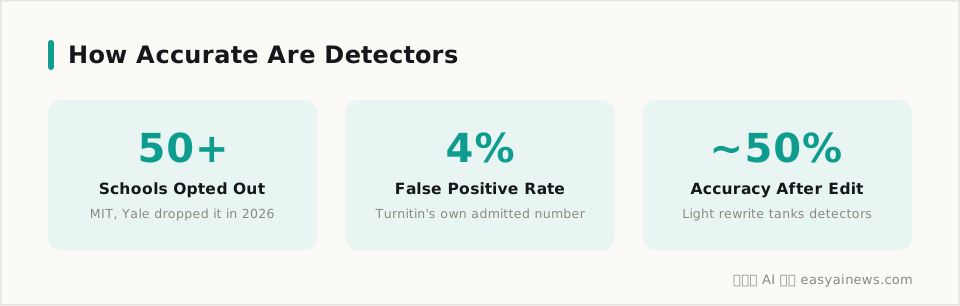
The biggest fight in US education this year has been a wave of top universities quietly turning their AI detectors off. MIT, Yale, Georgetown, and UCLA have all put out formal statements saying they no longer use AI detection scores to decide academic misconduct cases, and more than fifty universities have followed the same path. Even Turnitin, the plagiarism checker most schools already run, has admitted its own false positive rate climbed well past the one percent it originally advertised, closer to four percent in practice. Inside Higher Ed covered the wave in an August piece with a blunt headline: AI detectors are out, new assessments are in.
Paraphrasing makes it worse. Studies that ran AI-written text through a second tool for a light rewrite found detector accuracy collapsing to somewhere near a coin flip. You don't need anything fancy to pull this off. Cleaning up an AI draft in your own words, swapping a few phrases, reordering a sentence or two, is often enough to tank a detector that wasn't very reliable to begin with.
That "AI probability" number looks precise. It really isn't.
So if the tools are this unreliable, why do people keep getting flagged even when they never touched AI?
Why Might You Get Flagged Even If You Never Used AI?
Because what these tools measure is closer to "clean writing" than "AI-written text."
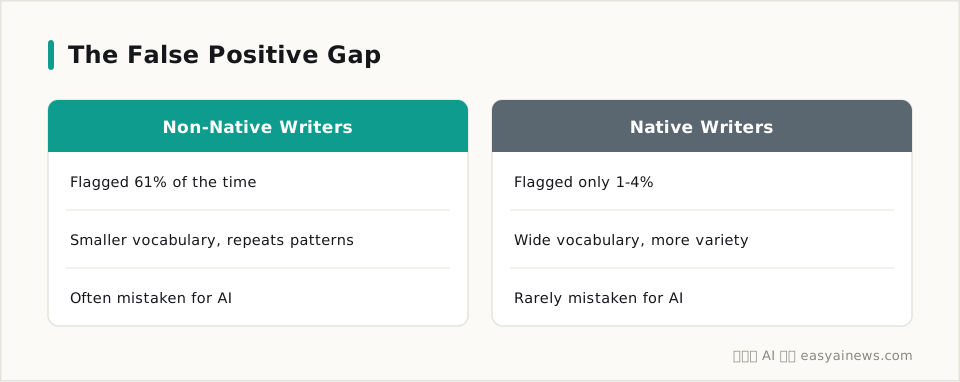
A team of Stanford researchers ran seven commercial detectors against essays written by non-native English speakers. The tools flagged those essays as AI-generated 61 percent of the time. Run the same tools against essays from native English speakers, and the false positive rate drops to somewhere between 1 and 4 percent. That's more than a tenfold gap.
The reason isn't mysterious once you see the mechanics. These detectors lean heavily on vocabulary variety, sentence regularity, and clean punctuation as signals of "AI-ness." Native speakers naturally draw on a bigger vocabulary and more sentence variety, so they slip past the filter. Non-native speakers work with a smaller vocabulary by necessity, repeat the same sentence patterns more often, and end up matching the exact profile these tools were built to catch. You spend years building up a few thousand words of a second language, and it still can't compete with the range a native speaker picked up without trying. Write carefully and correctly, and the reward is a "possibly AI" label.
One longtime academic peer reviewer described a very different approach: no tools at all, just a feel for the writing. Overblown adjectives, every paragraph opening like a pep talk to itself, the same phrase turning up three or four times across one piece, those are the signals that actually catch his attention. It's subjective, sure. But it doesn't automatically treat you as a suspect just because your vocabulary is smaller. A detector can't do that. It's reading surface statistics, not your actual writing.
You might assume this is a US university problem and nothing more.
Do Schools Outside the US Use These Tools Too?
Yes, and often the exact same system.
Look up the library guides at Taiwan's National Chengchi University, National Taiwan Normal University, or Tunghai University, and you'll find the same disclosure: they run Turnitin's built-in AI detection, and their guidance carries the same warning line almost word for word. The AI percentage cannot be used as the sole basis for an academic misconduct finding. The final call still belongs to a human reader.
That line isn't something a Taiwan university tacked on locally. It comes straight from Turnitin's own documentation, and schools everywhere are just repeating it. Even the company selling the tool admits the score is a reference point, not a verdict. If a percentage like this ever lands on your desk, wherever you are, that's worth remembering: the vendor's own paperwork says it isn't proof of anything.
So if the number does land on you anyway, what can you actually do about it, beyond quoting the fine print?
What Do You Do If You Get Falsely Flagged?
Start by pulling together whatever record exists of how you actually wrote the thing. That tends to carry more weight than any percentage.
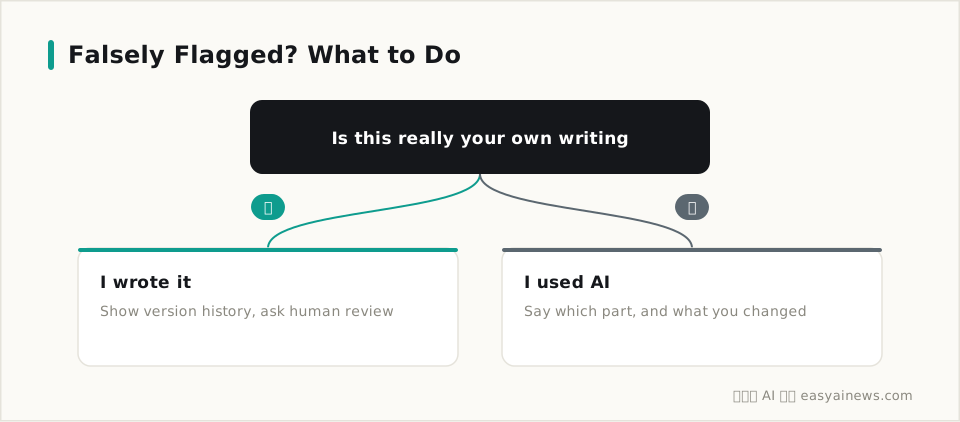
If you wrote it in Google Docs or Word Online, version history is already sitting there, showing every edit, delete, and revision along the way. That kind of gradual, visible trail is not something a single AI-generated draft produces. Handwritten notes, earlier drafts, screenshots of the sources you actually looked up, all of that counts as evidence too. Keep this stuff around as a habit, so it's there when you actually need it.
If someone waves that percentage at you, point straight back to the policy already covered here: a detection score can't stand alone as proof, full stop, and that's the vendor's own rule, not something you're making up to get out of trouble. Ask for other evidence, or offer another way to prove it, like walking through your reasoning out loud. Something you genuinely thought through holds up under follow-up questions. A copy-paste job usually doesn't.
If you did use AI, the more honest move is just saying so directly: which part, and what you did with it afterward. Most teachers and managers care less about whether you touched AI at all, and more about whether you're upfront about it and whether you actually understood what you turned in. A related piece here looked at what happens when kids do homework with AI: the homework grade looks great right away, but the exam six months later is where it catches up with them, and the difference always comes down to whether the thinking actually happened.
Three Things Worth Remembering
- AI detectors are less accurate than most people assume. More than 50 universities, including MIT and Yale, have dropped them this year, and even Turnitin admits its own false positive rate ran higher than advertised.
- Clean, well-structured writing can get you flagged for no reason. Stanford's research found non-native English writers get falsely flagged at more than ten times the rate of native speakers.
- Plenty of schools outside the US, including several in Taiwan, run the same system, and their own official guidance says the score can't be the sole basis for a finding.
- If you're falsely flagged, pull your version history or drafts as evidence and ask for human judgment, citing official policy. That works far better than arguing with a percentage.
The technology genuinely can't tell whether a piece of writing came from you or from AI, not reliably. Chasing that percentage is a losing game. Keeping a visible trail of the thinking you actually did is what holds up in the end.