Written together with AI. How, on the About
Kids Doing Homework With AI: The Test Is Where You Find Out What Stuck
A study of 26,000 middle and high schoolers found AI-assisted homework scores went up, but exam scores dropped months later. This explains why, and how a parent can tell whether their kid actually learned anything.
In this article
If your kid's homework grades have suddenly gotten a lot prettier, you'd probably breathe a little easier. A study that tracked 26,000 middle and high schoolers for two and a half years suggests that relief might be premature.
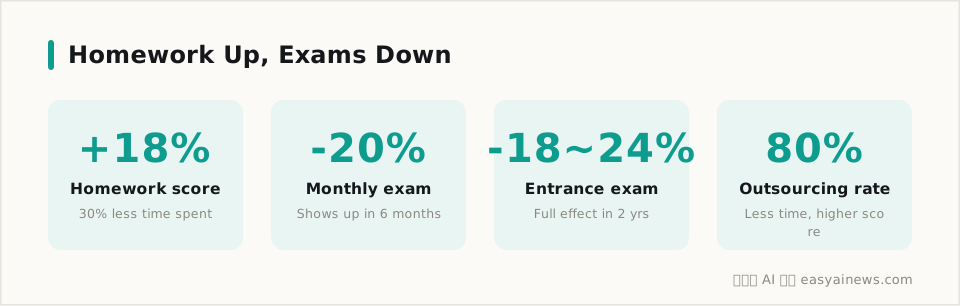
Researchers followed students from seventh grade through senior year in one county, recording their monthly homework scores, how long homework took them, and their results on monthly closed-book exams. Once students started using on homework, their homework scores rose 18 percent on average, and the time it took them dropped by roughly a third. Faster and better looking. Sounds like a win.
Six months later, the same students' exam scores had fallen by around 20 percent. The prettier the homework got, the harder the exam landed.
Is This Just a Coincidence?
No. The researchers matched the two effects to the same students, and the match holds up.
The old pattern was simple: kids who did well on homework usually did well on tests too, both moving together. Once generative AI became common, that pattern flipped for a lot of students. Digging further, the researchers found that about 80 percent of the students using AI on homework showed the same behavior: finishing unusually fast while scoring unusually high. Put plainly, most of that homework was AI's answer, copied over and handed in.
The effect isn't a one-time blip either. It grows the longer researchers kept watching. The exam drop shows up within six months; by two years out, the gap on high-stakes entrance exams widens to somewhere between 18 and 24 percent. The damage runs deepest in social studies, then math and science, then language subjects, and it hits younger students and previously higher-achieving kids hardest, the exact two groups most often held up as proof a child is "doing well."
How does a reversal like this even happen?
Why Does the Homework Look Better While the Learning Doesn't Stick?
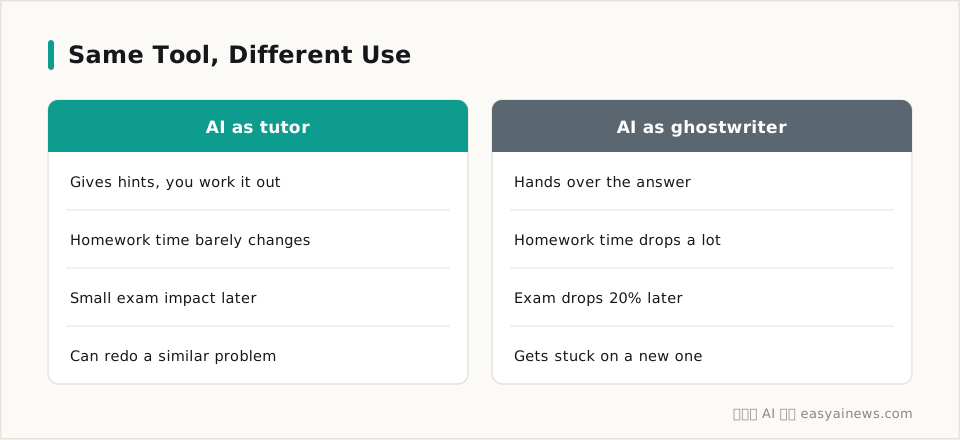
Because most kids are using AI to copy answers, not to ask questions.
Doing homework has always worked the same way: you get stuck, you work through it, your brain checks whether it's right, and that whole process is what makes the method stick. AI skips all of that by handing you the answer directly. You copy it, turn it in, and the page looks flawless, but the part where you actually worked through it never happened. Then exam day arrives, you can't look anything up, and the road you never actually walked turns out to be one you can't walk now either.
One detail in the study stands out. Among students who used AI, the ones whose homework time didn't drop much lost far less ground on exams. If the time wasn't saved, that's a sign they were asking AI why a step works instead of what the answer is, then finishing the work themselves once they understood it. That's AI standing by until the thinking is done, then checking the result, not doing the work in your place.
This Study Was Done in China. Does It Apply Anywhere Else?
The mechanism doesn't care what country you're in. Homework that gets done fast and looks great works the same way everywhere.
This particular study followed students in one county in central China, and no two school systems grade homework or run exams identically. But the mechanism it caught isn't tied to a specific country. Whenever there's a gap between "homework" and "a closed-book test where you can't look anything up," letting AI make the homework fast and polished doesn't make that gap disappear. Wherever you are, a closed-book test still checks what's actually left in a kid's head once the AI is gone, and that risk doesn't stop applying just because you're somewhere else.
Would Banning AI on Homework Just Fix This?
Probably not. A kid who wants to copy will find another way to do it.
What actually works is buried in the detail from a moment ago: whether homework time gets cut in half is what determines how much sticks. A related piece here looked at what happens to doctors and engineers once they lean on AI for a while, and the same logic applies to homework: whether AI helps you learn comes down to whether you got stuck and worked through it yourself first, or just copied the answer straight over. Swap the professional for a kid at a desk, and the mechanism holds.
How Can a Parent Tell If Their Kid Actually Learned It?
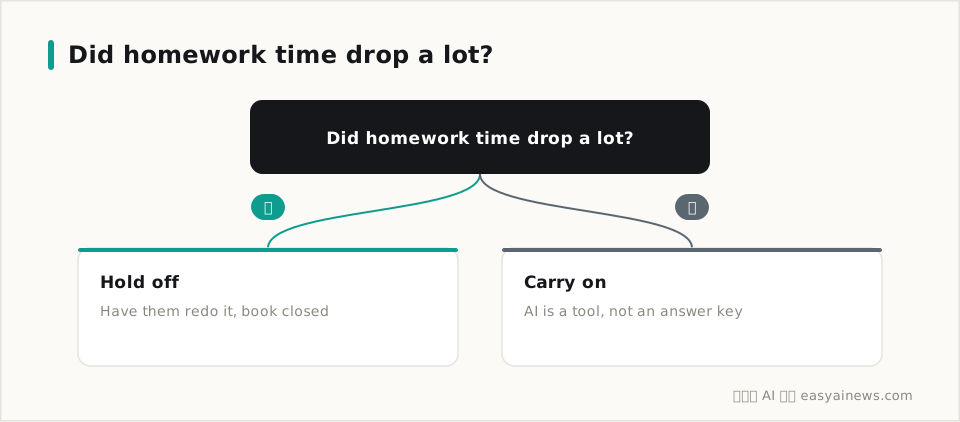
Watch how long homework takes, not just the grade. It's also the easiest signal in this entire study to check for yourself at home.
A night where the homework score suddenly looks great and it took less than half the usual time is worth one more question: could you redo this problem right now, on your own? You don't need to check every night. Pull out a similar problem occasionally, close the book, and ask your kid to solve it cold. If they freeze up or can only half explain it, that shiny homework grade was probably borrowed, and the exam is where the bill comes due.
You can also change how AI gets used in the first place. Swap "what's the answer to this" for "what's the first step I should think about here," so the AI only offers a hint instead of the answer, and your kid still has to walk the rest of the way alone. It won't feel any faster in the moment. But on exam day, that one habit might be the difference 🙂
Three Things Worth Remembering
- If a homework grade suddenly looks great and took less than half the usual time, hold off on the praise and have your kid redo a similar problem with the book closed.
- Get AI to give hints and let your kid work through the problem, instead of letting it hand over the answer directly.
- Younger students and kids who were already doing well are hit hardest by this, so it's worth paying a bit more attention either way.
A homework grade can fool a parent. It can't fool exam day. What's actually worth watching is whether your kid can sit down and redo that one problem on their own.