Written together with AI. How, on the About
Why Is AI Suddenly Buying Up Old Books? Is the Shredding Story Even True
A viral claim says AI firms are buying and destroying used books to train models. This sorts the news, court documents, and fact checks to explain what's confirmed, why AI wants old books, and whether it touches your own shelf.
In this article
You may have scrolled past this one already: AI companies buying up used books in bulk, then not reselling them. The books get their spines cut off, get scanned page by page, and the originals get destroyed once the scan is done. It comes with photos of stacked books waiting to be shredded, and it reads a lot like an urban legend.
This piece pulls together the recent coverage, the court filings, and what fact checkers actually confirmed, so you know which parts of this are real, why AI companies suddenly want old books, and whether it has anything to do with the books sitting on your own shelf.
Is Any of This Actually True?
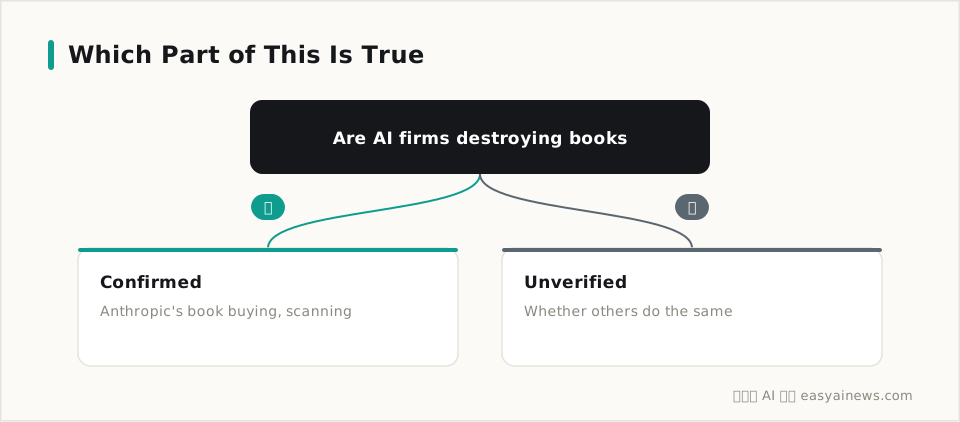
Part of it is confirmed. It just isn't as sweeping as the rumor makes it sound.
The claim first spread on social media in late July, riding along with screenshots of booksellers describing unusual bulk orders. Within days it had turned into "the AI industry is destroying human books at scale." Several major outlets and fact checking groups looked into it, and none of them landed on a flat yes or a flat no.
The confirmed piece is Anthropic. A copyright lawsuit led a court to unseal internal documents about a program the company called Project Panama, run by someone who had previously worked on Google Books. An internal memo from April 2024 states the project's goal plainly: scan and destroy every book in the world. That line comes from an actual company document entered into a court record, which is why fact checkers were willing to call this part confirmed.
The other name attached to the rumor is ISBNdb, a book database company. It once advertised on its own site that it could source anywhere from a thousand to a million books for AI labs, anonymously, with a stated preference for rarer and out of print editions. When reporters followed up, ISBNdb said the page was only testing market interest, that the service never actually launched, and that it has never trained an AI model or purchased or scanned a single book for anyone. Fact checkers left the question of whether other companies are doing the same thing unresolved.
In other words, the post you saw was mixing a documented fact with an unverified rumor and presenting them as one story, which is exactly what made it feel so extreme. A while back this site covered how to spot AI scams and fake messages, and this rumor turns out to be a decent live example of the same skill: check which part actually has evidence behind it before deciding whether to pass it along.
Which raises the more basic question. Even with just one company confirmed, why would old books suddenly become worth fighting over?
Why Do AI Companies Want Old Books?
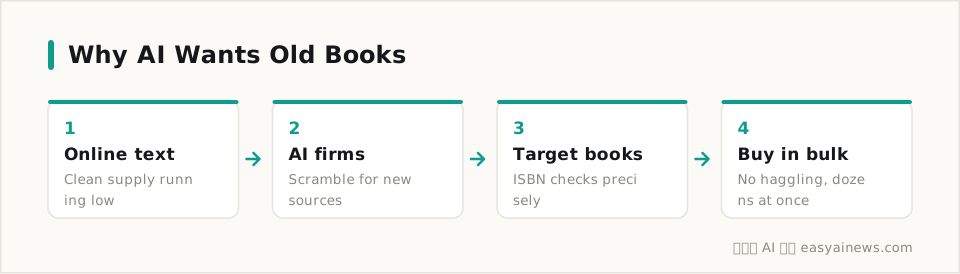
Because the clean, high quality text sitting online that AI hasn't already read is running out.
The estimate comes from a research group called Epoch AI, and several outlets circled back to it again this year with roughly the same conclusion: at the current pace of , the internet's supply of high quality, human written text could be fully absorbed by leading AI models as soon as 2026. Lower quality text will last longer, but it runs out too eventually, just later, sometime after 2030. Models keep growing, their appetite keeps growing with them, and the supply of clean, usable text hasn't kept pace.
Books happen to be exactly the kind of text that never made it online in the first place. A lot of older titles were never fully scanned or posted anywhere, and the content has already been through editing and proofreading, which makes it noticeably more reliable than a forum post or a social media comment. That is precisely what AI companies are short on right now.
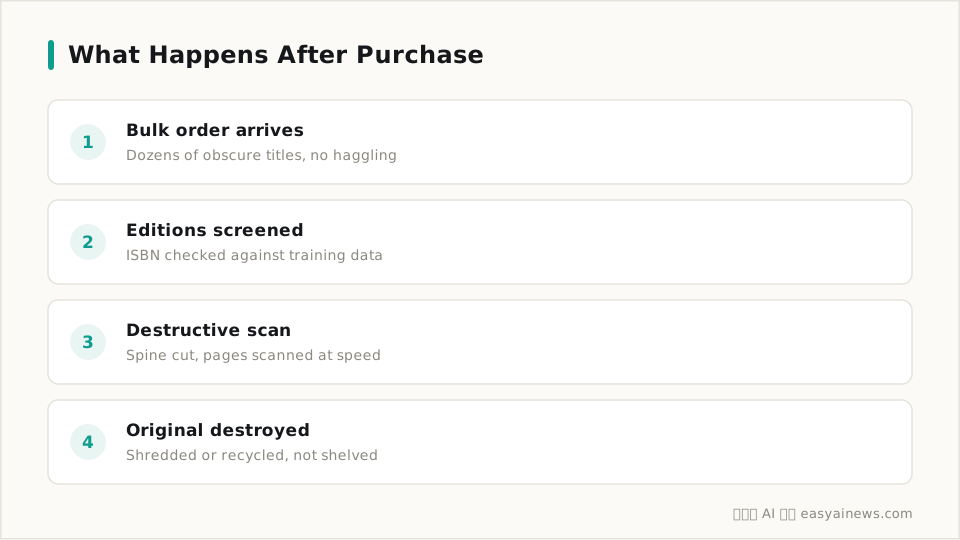
And ISBN, that thirteen digit code printed on the back of every book, happens to solve a very practical problem: knowing whether a given book has already been read by a model. Every edition carries its own ISBN, so an AI company can check it against what's already in its training data and go straight for editions it hasn't ingested yet, no duplicates. It's also why one bookseller in New York noticed buyers who cared about almost nothing except the ISBN matching. Condition didn't matter, and they'd buy dozens or even hundreds of completely unrelated, obscure titles in a single order without haggling over price. It doesn't look anything like how a collector buys. It looks like someone working down a checklist. That bookseller says this wave of orders alone has nearly doubled revenue compared with the same period last year.
Running short on data is only the first layer of this. What actually happens once a book leaves the shop is the part more booksellers are worried about.
What Happens to a Book Once It's Bought?
Most of them don't end up in a library or on someone's shelf. They get their spines cut off, get scanned page by page at high speed, then get destroyed or recycled.
The process is what's called destructive scanning. The spine is sliced off first so every page can be fed individually through a high speed scanner and turned into readable digital text, which is far faster than scanning a bound book page by page. Once the scan is done, the physical book usually doesn't survive. It goes straight into a shredder or a recycling plant.
A few booksellers grew suspicious about where their books were actually ending up, so some tried a low tech solution: slipping a small tracking device inside a book before selling it, then watching where it went. The tracking confirmed what they suspected. The books really were being routed to large scanning facilities or paper recyclers. That's left more than a few booksellers stuck with an uncomfortable tradeoff. This demand is turning years of unsold inventory into cash, which looks good on paper, but if what gets bought happens to be a rare edition, a signed copy, or one of the last surviving copies anywhere, that sale amounts to helping erase a piece of physical cultural history. The money's real. The object is gone for good.
Because of that, some booksellers have started drawing their own lines. When a buyer who seems like an AI purchaser asks specifically for a signed or rare copy, a few will quietly hold it back and send along an ordinary edition instead. There's no reliable way to confirm a buyer isn't an AI company, and that uncertainty is exactly what's making this wave of business feel so unsettling to the people selling into it.
That's a real dilemma for booksellers. For an ordinary reader, the question looks a little different. Could the books on your own shelf end up on someone's list next?
Could This Happen to the Books on My Own Shelf?
The odds are low. Most of these orders go to used bookstores or warehouses sitting on huge inventories, not to individuals selling a handful of titles.
Every transaction described in this story is bought at bulk scale, dozens to hundreds of books at a time, aimed at sellers holding tens of thousands of titles. Nobody's knocking on your door asking whether you'd like to sell the few dozen books on your shelf. For a data buying operation optimized around volume, a home collection just isn't efficient enough to be worth the trouble.
The people who should actually pay closer attention are the ones holding onto something valuable and planning to clear it out all at once, clearing out a parent's book collection after they pass, or emptying a whole bookcase during a move. If someone shows up in that situation offering to buy the entire lot without haggling and without much interest in condition or edition, it's worth asking one more question about what the books are actually for. That doesn't mean the buyer is automatically suspicious. It just means signed copies, out of print titles, and limited editions can't be put back together once they've gone through a destructive scan, so one extra question costs nothing.
Three Things Worth Remembering
- The only piece confirmed by court documents so far is Anthropic's Project Panama, buying and destructively scanning old books to train its models. Whether other companies are doing the same hasn't been verified, so don't forward the claim as settled fact.
- The real driver behind AI companies chasing old books is that high quality text online is running low, with Epoch AI's research estimating it could be depleted as early as 2026.
- These orders mostly go to used booksellers sitting on large inventories, not individuals, so the books on your own shelf are unlikely to be on anyone's list.
- If you're clearing out a whole collection, especially signed copies, out of print titles, or rare editions, and someone offers to buy it all without haggling, it's fine to ask what the books will actually be used for.
Whether old books stay in demand depends on whether AI is still short on data. Next time a claim like this shows up in your feed, check who actually has the evidence before you decide to share it.