 Easy AI News
AI-assisted, approved by the author. About
Terence Tao gave a talk about AI. Then everyone started arguing about cancer drugs.
A cancer-treatment analogy sparked an argument about Tao and AI. What do mathematical proof, scientific evidence and error correction actually establish?
In this article
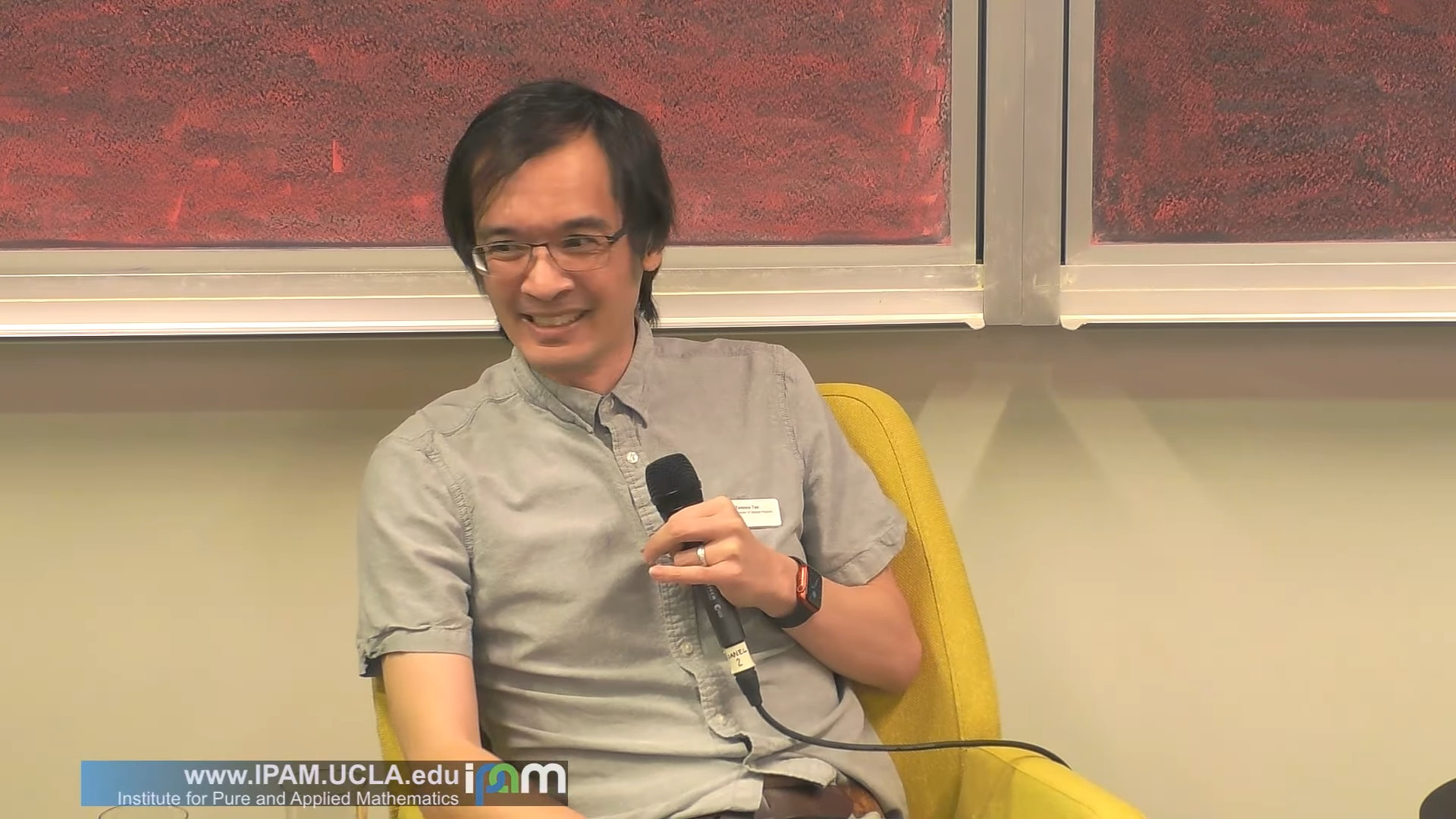
Terence Tao at an IPAM fireside chat, 4 March 2026. Institute for Pure & Applied Mathematics · Wikimedia Commons · CC BY 4.0. Image unchanged.

Since Terence Tao released the slides from his recent talk, an odd argument has been playing out on X: does the mathematician understand cancer treatment?
If you have not been following the discussion, two names are enough to get started. OpenAI, the company behind ChatGPT, has recently released a large collection of AI-assisted mathematical work. Terence Tao is a mathematician considering how these tools will change research. The argument grew out of his talk and eventually drew in doctors too.
It started with a drug-development analogy in a talk about AI and mathematics. Some readers thought the analogy was terrible. Others thought it was a bad example in an otherwise important talk. Still others argued that the critics had missed his point.
I think it was a terrible example too. But explaining why takes a little background on what mathematicians have been arguing about.
AI solves hard problems. What worries mathematicians?
On October 6, OpenAI released a large collection of mathematical manuscripts claiming solutions to difficult problems. The Association for Human Mathematics criticized the mass release and urged mathematicians to stop working with OpenAI. Tao reposted the association’s statement as a guest article on his blog.1
If you don't follow mathematical research, that may sound baffling. Why would people be upset about AI helping solve hard problems?
School mathematics usually gives you a problem and an answer. Get it right, get the marks. Research produces other things along the way. Working on one problem might lead you to invent a method or discover a connection between fields. You might never solve the original problem, yet someone else could use what you found to solve another one.
Tao's October 9 talk, Math 2.0, was concerned with that broader activity. AI can produce answers quickly. How do people absorb the results? What should the next generation of mathematicians learn and work on?2
Imagine a mathematics workbook with worked solutions to every problem. You can check an answer and follow the steps, yet still have no idea where to begin when tomorrow’s problem changes. For a researcher, understanding a proof often includes seeing why someone thought to take a particular step, so the method can help with the next problem.
That helps explain why counting the problems AI has solved does not answer all of Tao’s questions. As results arrive faster, people’s ability to absorb them, teach them and build on them deserves attention too.
Those are reasonable questions if mathematics is your life's work. Then he brought cancer treatment into the discussion, and a different group of people joined in.
A cancer analogy sends the discussion in another direction
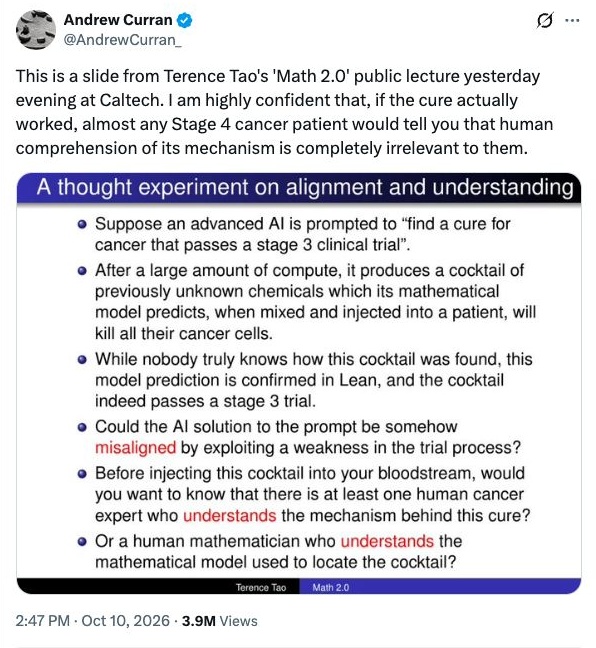
His hypothetical went roughly like this: an AI finds a combination of cancer drugs, supplies a mathematical proof, and the treatment passes a phase 3 clinical trial. But nobody understands how the AI found it. Before having it injected, would you want at least one expert to understand how it works?
He also asked whether the AI might have exploited a weakness in the trial process or its mathematical models to satisfy the request on paper.3
Andrew Curran, whose post brought the slide into this discussion on X, shared it with a blunt response: if the treatment actually worked, patients with stage 4 cancer would probably care very little about whether humans understood its mechanism.4
That reaction is easy to understand. For someone waiting for a chance at treatment, staying alive is more urgent than getting a complete explanation.
Physician Vinay Prasad went further, publishing an article arguing that Tao did not understand cancer medicine. Doctors already use drugs whose mechanisms are not fully understood, he wrote. Our knowledge of the body has plenty of gaps, but trials can still tell us that some treatments improve patients' outcomes.5
A missing account of exactly why a drug works does not leave doctors with no reason to use it.
Tao's defenders were concerned with another question: how do we know the AI has actually done what we wanted?
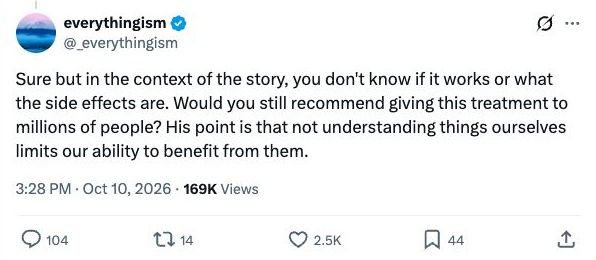
Replying to Curran, @_everythingism argued that a lack of understanding limits our ability to benefit from these results. A system can deliver something that passes a test, but applying it to more people and more situations still takes judgment.6
Other readers thought the cancer example was getting too much attention. One commenter on the technology discussion site Hacker News said that, despite finding those slides surprising, the rest of the presentation was still worth reading.7
Put these reactions together and the disagreement over “it really works” becomes clearer. One side already accepts that the treatment works and asks what we are waiting for. The other is still asking how we know, and how far that assurance extends. Without shared premises, the arguments quickly diverge.
Was Tao deliberately choosing a provocative example to attract attention? The slides and online reactions cannot tell us his intention. We can discuss the argument he actually presented.
Can a mathematical proof guarantee that a drug works?
Each reaction has a concern behind it. My objection is that the analogy brings mathematical proof and scientific evidence too close together.
They offer very different kinds of assurance.
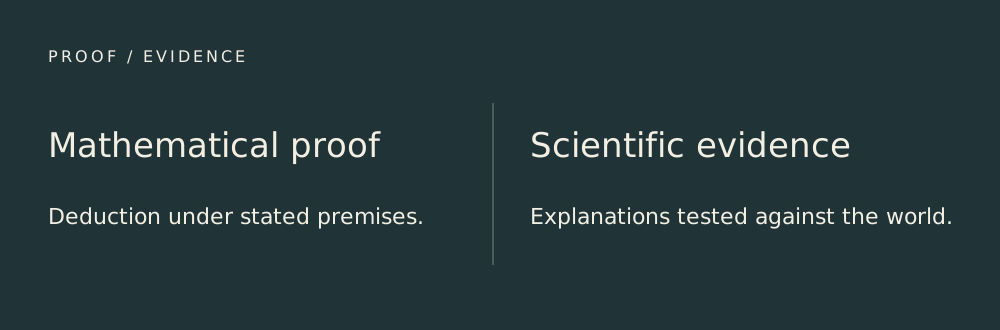
In mathematics, when the premises and reasoning hold, a correctly proved conclusion doesn't stop being true because someone runs another experiment tomorrow. If an AI produces a reliably checked proof, and we have also confirmed that it proves the claim we meant to ask about, I can accept the result without appreciating the ingenuity of the argument.8
Explanations of the natural world remain subject to new evidence. We may revise an explanation, or discover that it only holds under certain conditions.9
Consider a simple mathematical example: the sum of two even numbers is always even. We can derive that from the definition without trying every pair of even numbers. A drug working for one group of patients does not let us establish, in the same way, that it must work for everyone.
Mathematical premises matter too. The familiar statement that a triangle’s angles add up to 180 degrees assumes plane geometry. On a curved surface, things change. Confidence in a proof comes after its premises, claim and reasoning have been established.
Drug research works that way.
After a trial gets a good result, we still want to know who participated, how long they were followed, and what treatment was used for comparison. What happens in a different group? With longer use? Could a problem appear later that the trial did not reveal?
All of that sits behind the word 'effective.'
So I find the mathematical certificate in Tao's drug example a strange addition. You can prove that a derivation inside a model is correct. How closely the human body matches that model still has to be tested.
(The body won't rearrange itself to fit your assumptions just because you got the mathematics right.)
If I could know with absolute certainty that a treatment would work for me, without a cost I found unacceptable, I wouldn't need to wait for every mechanism to be explained before taking it. Medicine almost never offers that guarantee.
That is where understanding matters.
We need to know what our evidence supports, what remains uncertain, and whether a conclusion survives a change in conditions. That is different from being able to describe everything a drug does inside a cell. The mechanism may remain incomplete while the trial evidence is strong enough to justify action.
Understanding still matters when we know the answer
Back in mathematics, do we still want human understanding when a result is already known to be correct?
Of course. Understanding it might help us find better methods or solve other problems. But that value needs explaining in its own terms. Asking whether I would take a cancer treatment nobody understands doesn't settle it for me.
There are two kinds of understanding here. One is explaining how AI came up with a solution. Another is knowing exactly what it proved and which premises it used. The first can inspire further research. The second affects whether we can confidently use the result now.
When a computer checks a proof, what has it checked?
There is a catch, though: we shouldn't rush past 'already known to be correct.'
One name needs introducing here: Lean. It is a tool for checking mathematical proofs. Researchers express claims and deductions in a strict formal language so a computer can check them step by step. Think of it as a proof checker.
What the checker receives must match the question we intended to ask. The computer checks the formal proof submitted to it. Every paragraph of the accompanying explanation does not automatically receive the same seal of approval.
Researchers have found differences between parts of OpenAI's written proof and what its Lean code actually verifies. That adds another question: after the computer check passes, how much of the explanation we are reading has been checked too?10
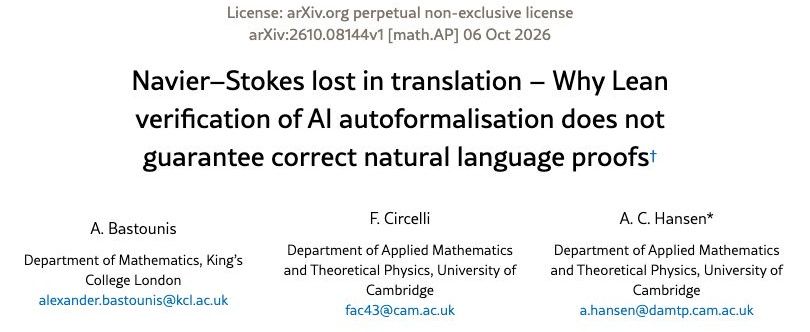
Separately, OpenAI withdrew three proofs after a sign error in one affected two others that depended on it. That was a different incident from the Lean discrepancies.11
Humans make mistakes too. Citing a paper can also mean inheriting its errors. But once researchers find a problem, they have to go back and check which of their conclusions it affects. If an AI repairs one step while other parts of the work keep using the old version, the package still has a problem.
Suppose you prepare a spreadsheet and a separate report. You later fix a faulty formula, leaving the spreadsheet correct, but the report still contains the old numbers. Saying “the spreadsheet has been checked” would not validate the entire report. This illustrates a consistency problem; it does not claim that every discrepancy in the mathematical paper above took exactly this form.
I wouldn't conclude from this that these AI systems are worse than humans at correcting mistakes. I want to know whether they can recognize a faulty dependency, abandon an answer they have been working toward, and carry a correction through everything that needs to change.
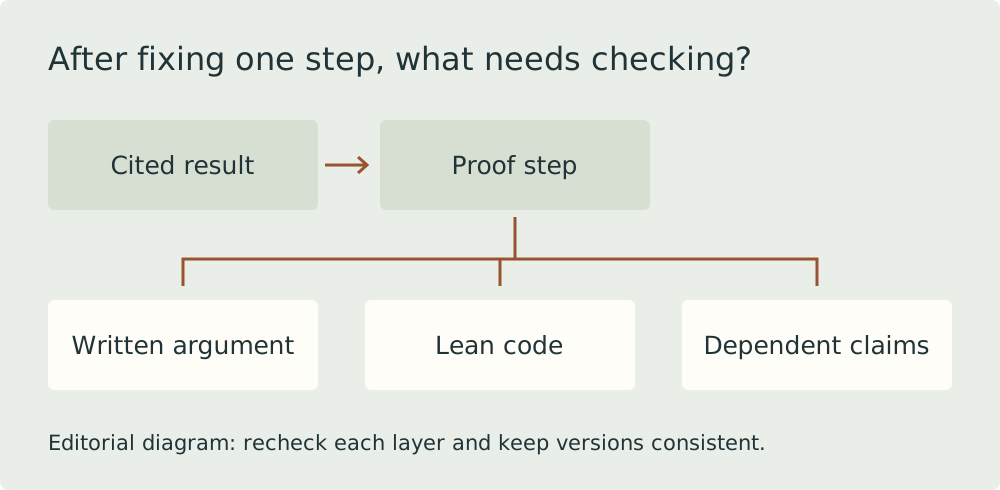
That gives Tao's emphasis on human understanding a practical role. Before accepting an answer, we may still need someone who can read the work closely enough to establish what 'proved' actually covers.
Mathematics offers better examples
I agree that human understanding matters. I would rather hear Tao develop the mathematical case: once AI has given us a correct answer, what important things can people still gain by studying it? That would explain his concern better than asking a cancer patient to decide whether to take a drug.
Sources and further reading
- AHM 聲明(陶哲軒部落格轉載)
- Terence Tao: Math 2.0
- Math 2.0 投影片
- Andrew Curran 的 X 原帖
- Vinay Prasad: Terrence Tao does not understand cancer medicine
- everythingism 回覆 Curran
- Hacker News: Terence Tao: Math 2.0
- Lean: Validating a Lean Proof
- National Academies: Understanding and Addressing Misinformation About Science
- Bastounis, Circelli & Hansen: Navier–Stokes lost in translation (v1)
- OpenAI mathematics: revision history