 Easy AI News
AI-assisted, approved by the author. About
Everyone is using AI. Why does it feel like we live in different years?
Karpathy’s four groups reveal a gap in AI experience. Work, access and the cost of checking results complicate the picture.

In this article
Andrej Karpathy. Photo: personal website.
Some people use AI to polish an email and still find it confidently wrong. Others delegate whole projects to it, then wonder how they will ever read everything it produces. Put them at the same table to discuss whether AI is useful, and they may soon suspect they inhabit different worlds.
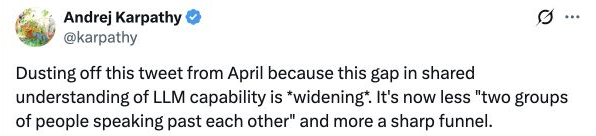
On October 11, AI researcher Andrej Karpathy described that gap as a funnel. He was a founding member of OpenAI and later led AI at Tesla. For readers unfamiliar with him, the relevant point is that he has spent years building, using and teaching AI. He argues that people’s direct experience of its capabilities is diverging.21
The observation is useful. So is a question it raises: when someone remains unconvinced, how much can we explain by saying they have not used AI deeply enough?
From two groups to four kinds of experience
Karpathy made a related argument in April. People whose impressions came from older, free chatbots were talking past professionals using the latest paid tools for programming, mathematics and research. His distinction already included the model, the field and the work being attempted. It was more detailed than a split between people who knew how to use agents and those who did not.3
An agent is an AI assistant that can take actions using tools. Ask for a registration website and it may create files, write code, run tests and respond to errors. How far it can go depends on the task, its tools and the permissions it receives.
In October, Karpathy expanded his description to four groups: people with little contact with these systems, occasional chatbot users, professionals using powerful models, and people with access to the most advanced internal systems.1
These numbers are his rough estimates. He explicitly describes them as napkin math, without providing a global user survey. They illustrate his observation; they should not be treated as measured population shares.
The striking divide is between professionals delegating substantial digital work and insiders who, in his account, see large teams of agents working on longer projects. Outsiders cannot independently examine the full capabilities of those internal systems under the same conditions.
The funnel combines access, task size, professional context and direct experience. It does not establish a route that everyone will follow.
Why programmers can feel a particularly dramatic change
Asking AI a question and delegating a project produce different experiences. The nature of the job matters too. Much programming work can happen inside a computer, with tests providing rapid feedback. A system can make a change, run a test and try again. Karpathy argues that progress is concentrated in digital, verifiable and commercially valuable domains.1
Caring for a patient, comforting a child or handling an unexpected customer problem involves a different mix of work. AI can help with parts of it, but the distance between advice and a resolved situation can be substantial.
One reply made that point sharply: much of the public is busy with care, education, transport, cleaning and the physical infrastructure that makes online life possible.4
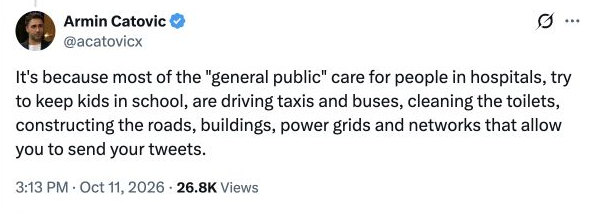
A programmer may save days by delegating a large task. A caregiver may save time on documentation while much of the day remains unchanged. Their different assessments of AI can both reflect real experience.
Karpathy acknowledges this unevenness himself, including the reasonable view of some nontechnical friends that they have little use for it. A retelling that dismisses every unimpressed person goes further than his post does.
Does indirect use count?
Another respondent asks what it means to use AI. If someone uses an app partly developed with AI, should that count? People often encounter a technology through finished products without operating the underlying infrastructure themselves.5
Directly instructing an agent can reveal its strengths and limitations. Benefiting from an AI-enabled product is also a real experience, though it teaches something different. A chatbot subscription alone cannot tell us how much a person is affected.
A more optimistic reply offers an example. A user says he gave his father, who had no professional coding background, access to a paid tool. His father then built a website for his business with payments. The writer argues that people need demonstrations tied to their own needs.6
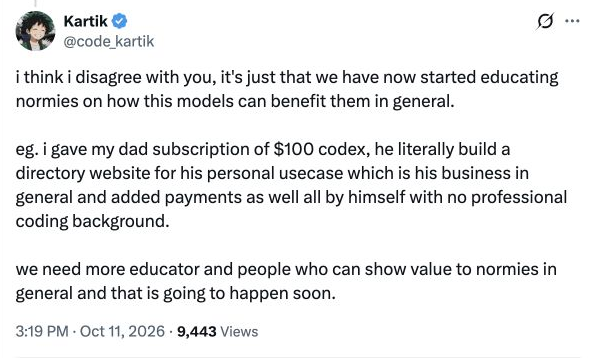
This is a personal account. We have not tested the website’s security or completeness. Still, it suggests a practical possibility: some people may be one relevant problem and a little guidance away from discovering a useful application.
“Better reasoning in the latest model” may mean little to a shop owner. “Can it help organize customer bookings?” is a much more tangible starting point.
Insiders also see only part of the picture
The criticism runs in the other direction too. Ethan Mollick, a professor studying AI applications, argues that even people with advanced internal access have not explored the full range of uses. Attention remains concentrated on cybersecurity, mathematics and AI research, while other fields have problems waiting to be addressed.7
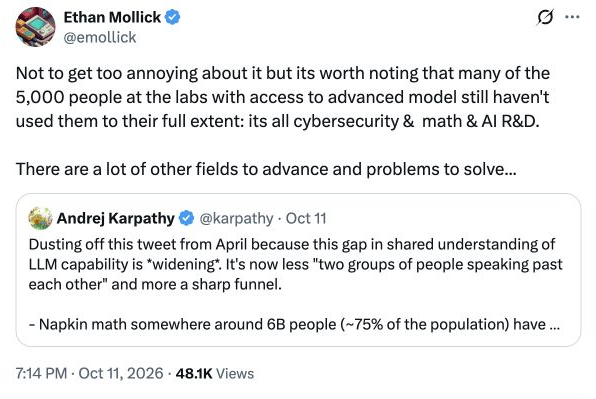
Access to a powerful tool does not remove the influence of professional habits. Someone who works on software vulnerabilities will naturally test that capability first. People who understand the problems in another field may lack the same tools or conditions for experimentation.
Clément Delangue asks whether concentrated capabilities also mean concentrated power. Garry Tan offers an optimistic expectation: prices will fall and more people will get access and bring those capabilities to the world.89
One concern is about the present barrier; the other is a prediction about diffusion. How far prices fall, what becomes available and when it becomes useful to ordinary users remain questions for actual developments to answer.
When output grows faster than understanding
Some replies come from people already using AI extensively. One says his own system produces more than he can read and understand. Another says he cannot be comfortable with software projects whose code receives no human review.1011
Together, they describe a recognizable change in the problem. First you worry that AI cannot do the work. Then it can produce the work faster than you can examine it. Who checks the result? How much time will maintenance, rework and responsibility for mistakes require?
(Adding ten AI assistants is easy. You still have only two eyes.)
Karpathy explicitly notes that human review and comprehension are falling behind. This concern belongs inside his account and should not be presented as something he entirely overlooked.1
There are also public examples of agent collaboration. Anthropic, the company behind Claude, has published an account of multiple agents developing a C compiler, a tool that translates programs into an executable form. Its report includes code, tests and limitations that readers can examine.12
That company report does not independently establish everything claimed about internal systems. Producing a substantial project and making it dependable across situations are separate achievements.
For users, a useful assessment includes the time spent checking, correcting and taking over the output. Only then can we see how much effort was actually saved.
Try more, and leave room for disagreement
I agree with one lesson of the funnel: a brief encounter with an old chatbot is a weak basis for judging what current AI can do. Trying a substantial task you actually care about can make both its strengths and limitations much more concrete.
But when someone has tried it and still finds limited value, we should ask about their work. They may have chosen an unsuitable tool, missed a useful approach, or encountered a problem that current AI does not help with very much.
Before asking whether someone thinks AI is impressive, I would ask which tool they used, what they asked it to do, and how much effort the result took to check.
Deeper use can improve our judgment. Being astonished by it does not need to become another test we have to pass.