Written together with AI. How, on the About
Does Leaning on AI Too Much Make You Worse at Doing It Yourself? What Two Studies Found
New studies on doctors and engineers found that relying on AI regularly leaves people noticeably worse at the task once the AI is gone. Here's how that happens, when it's worth worrying about, and a simple way to decide.
In this article
Ever had this happen: your GPS loses signal on a route you've driven a dozen times, and you freeze because you can't remember which turn comes next? Or your calculator battery dies and simple two digit addition suddenly takes forever? These abilities don't vanish on their own. Usually it's because you handed the job to something else for too long.
Two separate studies, one tracking doctors and one tracking engineers, were recently covered together in the same Nature piece. The question they're asking is direct: once you get used to letting AI do something for you, and it suddenly isn't there, how much can you still do yourself? The answer isn't great. This piece lays out how that actually happens, when it's worth worrying about, when it isn't, and a simple way to decide which is which.
What the Studies on Doctors and Engineers Actually Found
Both studies point the same way: take the AI away and people perform worse than they did before they ever had it.
The first study followed endoscopists in Poland. Every doctor in the group had performed at least two thousand colonoscopies, seasoned professionals by any measure. Their clinic rolled out an AI system that flags likely precancerous growths in real time during the procedure. Researchers specifically tracked how doctors performed during stretches when the AI happened to be switched off, comparing that against how they did with it running.
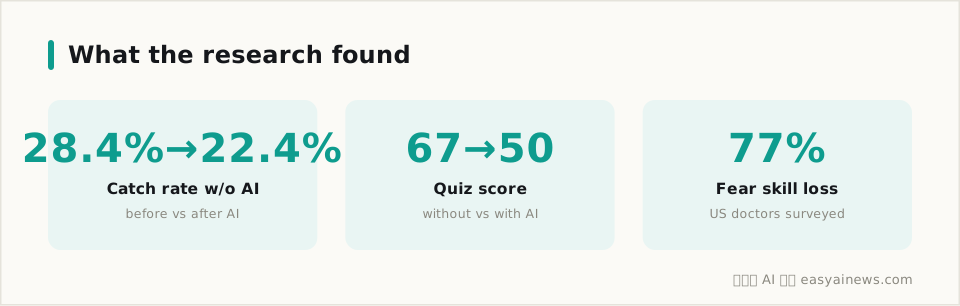
Before the AI was introduced, doctors caught these growths on their own 28.4% of the time. After the AI arrived, on days it was off, that number dropped to 22.4%. Get used to having something flag things for you, and your own eye gets a little less sharp.
The second study looked at software engineers. Anthropic ran a randomized trial with 52 engineers, half allowed to use an AI assistant while coding, half working with just their own research. After the task, everyone took a quiz on what they had just built. The group that used AI scored 50% on average. The group that didn't scored 67%. The AI group did especially badly on questions asking them to spot bugs in the code. They could produce working code without actually understanding what it did.
A lot of people already share this worry. A recent US survey by the healthcare information company Wolters Kluwer found that 77% of physicians and 70% of nurses are concerned about losing their own skills from relying on AI too much.
Why "AI Did It" and "You Did It Yourself" Leave Such Different Marks
This comes down to how much effort you actually put into figuring it out yourself.
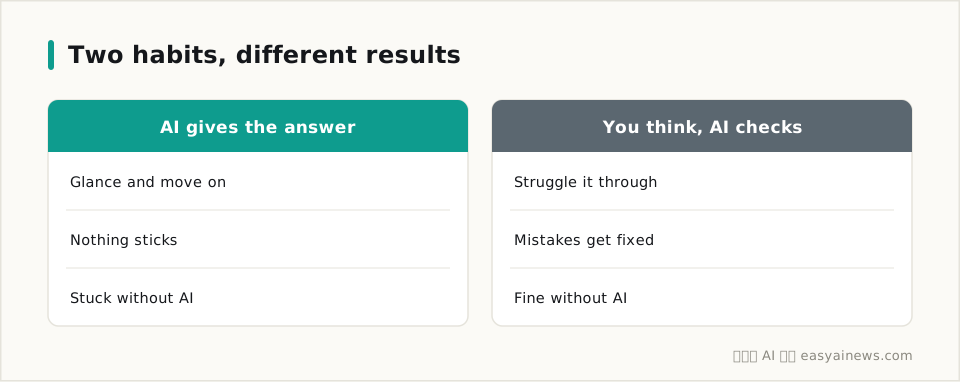
Learning something sticks because of the whole process behind it: getting stuck, working through it, checking whether you got it right. Just seeing the answer doesn't teach you much. Doctors build a sharp eye for scans because every past read required their own judgment call, right or wrong, and they learned from both. Engineers understand code because writing it means wrestling with the parts that don't work, and the wrestling is where the understanding comes from.
AI skips that whole process for you. It hands you the answer directly. You glance at it, it looks reasonable, and you move on. There's nothing wrong with saving effort, but without that stretch of figuring it out yourself, your brain never gets the chance to file it away. Next time you hit something similar and the AI isn't around, you find out you never actually learned it.
Is This Only a Concern for Doctors and Engineers
Both studies looked at specialized professional skills, which might sound like it has nothing to do with everyday life. But the same logic applies to anything you'll keep having to do yourself going forward.
People who always ask AI for a first draft eventually notice they freeze up staring at a blank page on their own. People who have AI summarize every meeting get used to reading the tidy recap and lose the knack for catching what actually mattered while it was happening. Even something as basic as finding your way works the same way. Rely on GPS long enough, and the moment it drops out, you can't find your way home. That's not because your sense of direction was ever bad. It's because that muscle hasn't been used in so long.
Whether it's reading a scan, writing code, drafting a message, sitting through a meeting, or finding your way somewhere, the principle holds: for anything you'll still need to do yourself down the road, doing it the hard way once in a while, sticking with it even when you get stuck, is what keeps the ability in your head.
Does That Mean You Should Just Stop Using AI
At this point you might be thinking the answer is to avoid AI altogether. What the research actually shows is less extreme than that.
There's a detail in the engineering study that's easy to miss: engineers who got to research the problem and think it through first, before touching AI, didn't lose much on the quiz at all. The real dividing line is between AI handing you the answer directly and thinking it through yourself with AI only there to check your work. Those two habits leave completely different things behind.
I wrote before about which jobs AI is likely to replace and which ones it isn't, and the point there was that people who can judge are worth more than people who can just execute. This is the same idea from a different angle. AI is good at producing an answer. Whether that answer actually makes sense, whether it's worth trusting, still comes down to your own judgment, and judgment is only built by thinking things through yourself.
Should You Practice This One Yourself
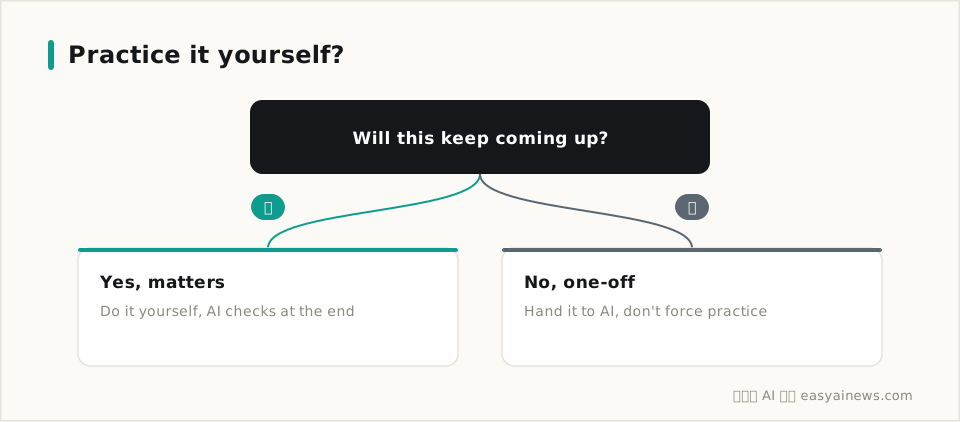
You don't need to redo everything from scratch by hand, or there would be no point using AI at all. Here's a simple way to decide: ask yourself whether you'll keep running into this regularly, and whether actually understanding it matters to you.
If the answer is yes to both, something you'll keep facing at work, a health condition you'll be managing long term, a route you walk every day, it's worth doing it yourself now and then, sticking with it through the hard parts, and saving AI for checking your work at the end.
If it's a one off, and understanding the details won't help you later, drafting a message you'll never send again, looking up something you only need once, just let AI handle it and don't force yourself to practice. Save that effort for the things that actually need it.
Three Things Worth Remembering
- For things you'll keep needing and that matter to you, do them yourself now and then, stick with it through the hard part, and don't let AI hand you the answer every single time.
- For one off things that won't affect you later, hand them to AI without guilt.
- When you do use AI, try thinking it through yourself first, then check your answer against it instead of copying straight away.
- If you notice you can't do something anymore without AI, that's your cue to go do it by hand again.
AI is genuinely useful, and none of this means you should use it less. Just leave yourself the occasional chance to do it by hand, so the skill doesn't quietly disappear.