Written together with AI. How, on the About
Job Hunting in the AI Era: Why Mass-Applying Gets You Fewer Replies, Not More
AI made writing resumes, cold outreach, and scheduling posts nearly free, so everyone now holds the same "mass-produce" button. Two real stories explain why applying to more jobs gets fewer replies, and which kind of effort is actually worth your time.
In this article
You've probably sent out your fiftieth, maybe hundredth resume by now, and your inbox has little to show for it: a few read-and-ignored messages, or form-letter rejections. You start wondering if you're just not good enough, so you get AI to help again, polish the resume further, make the cold email more polite, and keep sending.
Faster, more, more polished. In theory that should mean more opportunities. For a lot of people, the real experience runs the other way: the harder they apply, the fewer replies they get.
This piece is about a rule of the game that AI has quietly rewritten over the past few years. Applications used to be proof of effort just by their sheer number. Now everyone holds the same button, so volume stops being scarce. Once you see what actually gets someone remembered after that rewrite, you'll have your answer.
Why More Applications Means Fewer Replies
Because past a certain volume every application looks the same, and the person on the other end stops reading them one by one.
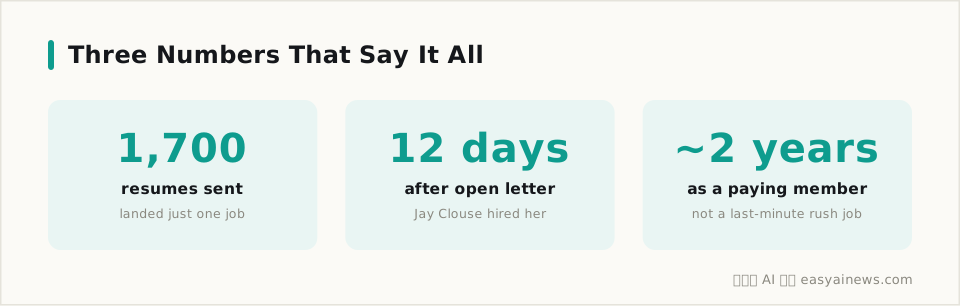
Fortune reported a case in 2024: a 22-year-old fresh out of business school sent over seventeen hundred resumes in ten months and landed exactly one job, selling phones at Costco.
This story gets a new face every few months, the numbers keep climbing, and the conclusion is always the same: the market is broken, it's not your fault.
Creator Justin Welsh offers a different read in a piece called "Mediocrity at scale." He's built two companies past a billion-dollar valuation and now writes a newsletter to over two hundred thousand readers every week, so he's seen plenty of job applications and business pitches. His take is unsentimental: volume was never a proxy for quality, and often it's the opposite. AI can polish your resume, tailor your cover letter, and send applications while you sleep. Volume itself stopped being worth anything, because it's the exact same effort every competitor can produce too.
Seventeen hundred resumes, all landing in a box already full of things that look the same. The volume was already there. The problem is that everything inside the box looks about the same.
The same logic shows up elsewhere too. The earlier piece "Rationality Surplus" covered this same pattern: AI pushed the cost of "producing something that looks reasonable" toward zero, so reasonable output is now available in unlimited supply, while genuinely sound judgment stays exactly as scarce as before. Resumes, cold emails, social posts: all replaying the same script.
Mass Flyers, or a Hand-Cut Key
To take this apart, borrow a concept that's over a decade old. In 2013, Y Combinator co-founder Paul Graham wrote a short essay called "Do Things That Don't Scale," urging early-stage founders to go do the things that can't be scaled up.
His favorite example is Airbnb. Users back then were clustered in New York, but the founders were sitting in California. Graham told them to fly out, knock on doors one by one, and personally reshoot the messy photos hosts had taken of their own listings. The founders' first reaction was that this couldn't possibly scale. Graham's answer: that's exactly why you should do it, because it's the one point in your company's life when you're small enough to know every single customer.
That advice cuts especially sharp today, because it maps onto a split between two kinds of things.
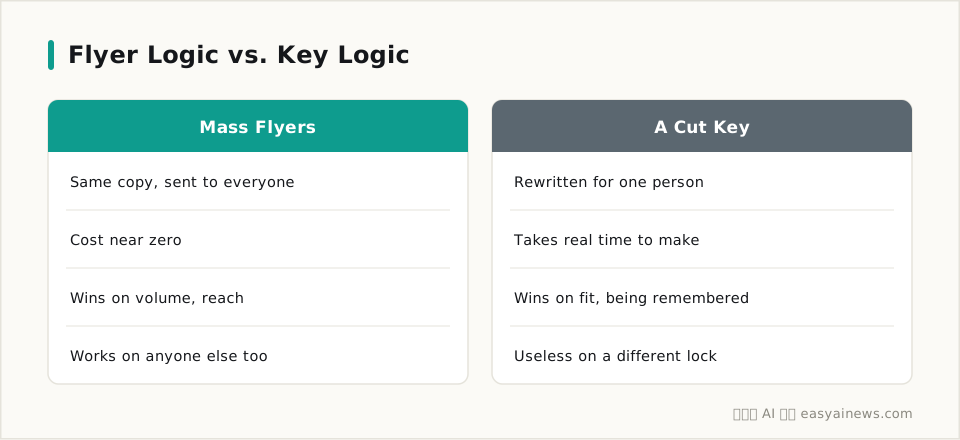
A flyer is horizontal. Print a thousand of them, each one identical, and the marginal cost barely moves, so you never need to know who's receiving it; the logic is coverage. A key is vertical, cut groove by groove to fit the inside of one specific lock. Swap the lock and it's a useless piece of metal. The logic is fit.
What AI did was push the cost of printing flyers toward zero. It also did something messier at the same time: it made everyone's flyers look equally polished. Flyers got cheap. The craft of cutting a key, by contrast, just got more expensive.
One Open Letter That Beat a Thousand Resumes
The next story has more warmth to it. Jay Clouse founded Creator Science, a creator-education community with a paid membership tier called The Lab. He was about to have his second child this year and planned to take two months of parental leave, while also setting himself a goal of doubling the business with less of his own time in it.
If he'd posted a public job opening, his inbox would likely have flooded with AI-polished resumes: fluent, glossy, flawless, and each one interchangeable enough to send to anyone else.
Anna Reich took a different path. She's a member on The Lab's cheapest plan, has followed Jay for close to two years, works as a management consultant, and was unemployed herself two years ago. On her own site, she wrote an open letter titled something like: "If I were on his team, here's how I'd help Jay get ready for parental leave in six months."
Before writing it, she read through every business update Jay had sent members, listened to his recent podcast episodes, dug up an old post where he'd admitted the bottleneck in his business was himself, and interviewed several members who hadn't renewed to surface what they hadn't said out loud. In the letter, she named six specific things, none of them flattering, including that Jay had always hired specialists but never anyone to manage them, which meant he was permanently stuck being the one managing everything himself.
Twelve days later, Jay commented on her post. Plot twist: he hired her.
Three Things AI Can't Do
This story is worth a second look: exactly which parts of what Anna did are things AI can't do.
Gathering material: AI can do that. Summarizing a podcast, combing through posts, laying out a timeline, it does all of that a hundred times faster than a person. Writing fluency, AI already wins there too. But there are three places it can't follow.
First, judgment. Out of dozens of hours of material, Anna had to decide which six things were worth saying. That's a different skill from gathering: it's about what you leave out, and you only know which line matters to someone once you actually care about them.
Second, nerve. Anna was willing to write a paragraph pointing out where Jay had fallen short. AI has a built-in blind spot here: it's trained to please, to keep you satisfied, which makes real neutrality hard for it. It'll happily list six things you did well, but it won't take the risk of naming an uncomfortable seventh.
Third, putting yourself in someone else's position. Anna personally interviewed members who'd churned: found them, scheduled time, actually listened to what they said. None of it required any technical skill, and it produced the single heaviest line in the entire letter.
Where AI Helps, and Where You Still Have to Fill In
AI still has a real role here. Lee Robinson, VP of engineering education at Cursor, has looked at hundreds of engineering applications and distilled a few pieces of advice that work almost like a field manual for this.
He thinks a resume shouldn't run past one page: the point is letting someone quickly grasp the one thing about you most worth remembering, not cramming in everything you've ever done. A personal site or portfolio can add depth as a link, but it needs to show real effort; a page that's obviously AI-generated, rough and hollow, actually costs you points. When applying to different companies, tailor the resume each time: startups care whether you can build something fast, while large companies filter through an applicant-tracking system first, where keywords and standardized experience are what actually gets through.
He specifically warns against letting AI write your cover letter or resume copy directly. Use it to brainstorm angles, gather material, compare phrasing, but write the final sentences yourself, so you don't fall into the overused, obviously-default-AI-output sentence patterns. The writing doesn't need to be fancy, but it needs to sound like an actual person, and ideally like you specifically. He also stresses that quality is what's being judged, not volume: three pieces that are genuinely thoughtful, specific, and show real thinking will out-argue twenty-seven templated ones.
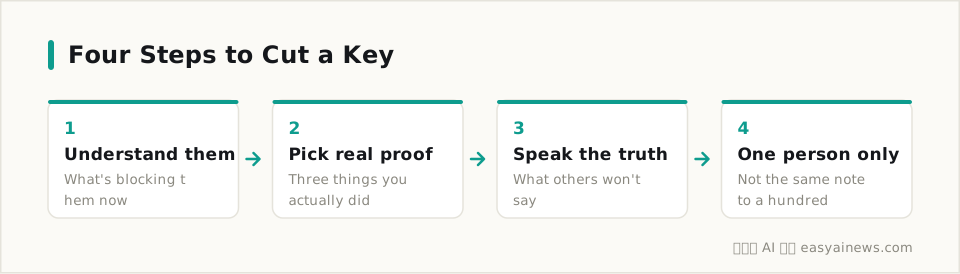
Whether you're applying for a job, cold-emailing prospective clients, or trying to join a community, the need is the same: first understand exactly what the other person is stuck on, then pick one thing nobody else could offer, and say it clearly to that one person. Don't send the same letter to a hundred people.
If You Only Remember Three Things
- Spend the time AI freed up on "understanding this one person," not on "sending ten more"
- Adjust your resume, cold email, or pitch at least once for each specific person. Don't run the same one everywhere
- Rewrite the final draft in your own words, so it doesn't read as one long stretch of obvious AI phrasing
- Find one specific thing nobody else could say but you, put that in, and cut the rest
Next time you're about to send a resume or a pitch, pull out Anna's line, "If I were on their team, how would I help them," swap in the specific person and company you're trying to reach, and actually ask yourself that question first.